

What Is The Cost Of Borrowing Money
Our use of cookies
We use necessary cookies to make our site work (for example, to manage your session). We'd also like to use some non-essential cookies (including third-party cookies) to help us improve the site. By clicking 'Accept recommended settings' on this banner, you accept our use of optional cookies.
| Necessary cookies | Analytics cookies | |
|---|---|---|
| Yes | Yes | |
| Yes | No |
Necessary cookies
Necessary cookies enable core functionality on our website such as security, network management, and accessibility. You may disable these by changing your browser settings, but this may affect how the website functions.
Analytics cookies
We use analytics cookies so we can keep track of the number of visitors to various parts of the site and understand how our website is used. For more information on how these cookies work please see our Cookie policy.

What are interest rates?

KnowledgeBank
An interest rate is a percentage charged on the total amount you borrow or paid on the amount you save.
Even a small change in interest rates can have a big impact. It's important to keep an eye on whether they rise, fall or stay the same.
If you're a borrower, the interest rate is the amount you are charged for borrowing money – a percentage of the total amount of the loan. You can borrow money to buy something today and pay for it later.
Interest is what you pay for the privilege. It's the cost you pay to 'hire' someone else's money.
If you're a saver, it's the same except the interest is paid to you – because banks are paying to hire your money.
What is Bank Rate?
'Bank Rate' is the single most important interest rate in the UK. It is our job to set this interest rate. We explain why we decide to keep the rate the same or change it in our Monetary Policy Report.
In the news, it's sometimes called the 'Bank of England Base Rate' or even just 'the interest rate'.
We use Bank Rate in our dealings with other financial institutions, which influence lots of other interest rates in the economy. This includes the various lending and savings rates offered by high street banks and building societies.
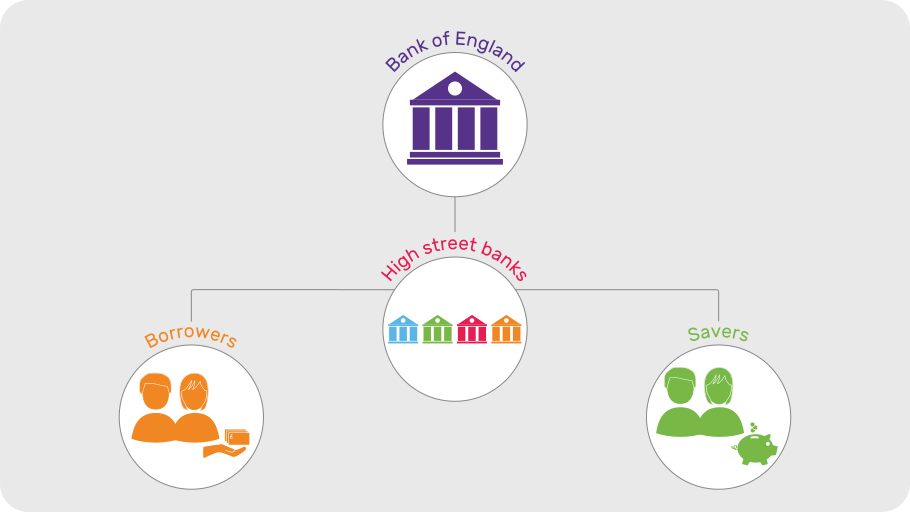
Why are there so many different interest rates?
The number of different interest rates available when you borrow or save can be confusing.
The interest rates high street banks set depend on more than just Bank Rate.
For loans, other factors are considered, including the risk of the loan not being paid back The greater the bank thinks that risk is, the higher the rate the bank will charge. It can also depend on how long you want to take out a loan or mortgage for.
You can use our interactive chart to see how interest rates of different financial products have changed over time. Choose a product from the drop down menu in the 'enter the series' box.
Why do interest rates matter to me?
Bank of England's KnowledgeBank guide to why do interest rates matter.
-
Hi, my name is Geoff and I work at the Bank of England. Today I'm going to tell you about interest rates. Interest rates were cut sharply in 2009 and remain extremely low by historical standards. With rates so low for so long do they really matter anymore? Yes they do.
Whether you're running a business or a family on a budget, interest rates continue to affect our daily lives and have a big impact on what's left over to spend on essentials each month. For most, interest payments on a mortgage are one of the biggest outgoings. Covering the cost of spending on credit cards and pay day loans can also be a big drain. Many of those with savings rely on interest payments from the bank to provide essential income to live on. So whether you're a saver or a borrower, the level of interest rates for you and your family, really does matter.
If interest rates rise, borrowing could become more expensive for you. Whether you are looking to get a mortgage to buy a house, or a new car on credit, it's crucial to think about what steeper costs mean for you.
Imagine you have a £130,000 mortgage that you want to pay off over 25 years. If the interest rate on the mortgage is 2.5%, the monthly repayment will be £583.
But if the interest rate is 1% higher, the monthly repayment will be higher, at £651.
Of course, interest rates can go down as well as up. If the mortgage interest rate was 1% lower, the monthly repayment would be around £520.
It's key to understand how a change in interest rates could impact your money. You can use a mortgage calculator Opens in a new window to work out how your monthly payments might be affected.
You may also be interested in...
Thanks! Would you like to give more detail? Press Spacebar or Enter to select
What Is The Cost Of Borrowing Money
Source: https://www.bankofengland.co.uk/knowledgebank/what-are-interest-rates
Posted by: pattersonyoustand.blogspot.com
0 Response to "What Is The Cost Of Borrowing Money"
Post a Comment