

Nvidia GeForce RTX 3070 Ti Review
A calendar week ago Nvidia released the GeForce RTX 3080 Ti and feedback from reviewers was almost entirely negative. There wasn't a lot to similar equally Nvidia is charging eighty% of the toll for an RTX 3090, but only gave gamers half as much memory and a much smaller FE graphics menu. Put differently, the Ti is an RTX 3080 with 2GB more VRAM for a 71% increase in toll. The extra cores amounted to a 10% boost on boilerplate, so a negligible performance uplift. Should we also mention the fact that you lot can't really buy it anywhere?
For gamers, the RTX 3080 Ti is a bomb, but for Nvidia it allows them to cash in big time on silicon that wasn't good enough to be binned for use equally an RTX 3090, extending their turn a profit margins. Then that's the story of the RTX 3080 Ti, but what about the RTX 3070 Ti?

The GeForce RTX 3070 Ti comes in at half the price, which is quite incredible and just goes to show how ridiculous the 3080 Ti's pricing is. The fifty% reduction in toll sees a 40% drop in cadre count, 14% fewer ROPs, 33% less memory bandwidth and capacity. The new Ti is based on the same GA104 silicon equally the RTX 3070.
With an MSRP of $600, the RTX 3070 Ti slots in between the 3070 and 3080. That means it's 20% more than expensive than the 3070, at least at MSRP, and for that you're getting just four% more cores with no increase in ROPs. That's a minuscule upgrade to the core, but thankfully Nvidia has tweaked the retentivity, opting to upgrade the GDDR6 retentiveness with GDDR6X at the same 8GB capacity.

The upgrade to xix Gbps memory from 14 Gbps means that the 256-fleck broad retention autobus now has a theoretical peak bandwidth of 608 GB/s up from 448 GB/s, a 36% increase.
While nosotros're looking at a piddly four% increase in cores, the 3070 Ti does ameliorate retention bandwidth by 36%. How much this volition improve operation overall volition likely vary from game to game, so that might aid make the testing a bit more interesting.

With that said, let's get over a few of the benchmarks using the Founders Edition bill of fare. All benchmark results are based on AMD and Nvidia GPUs running at the official specifications, so no factory overclocking. In total we tested 12 games at 1440p and 4K using our Ryzen 9 5950X examination arrangement, which has been configured with 32GB of dual-rank, dual-aqueduct DDR4-3200 CL14 memory.
Benchmarks
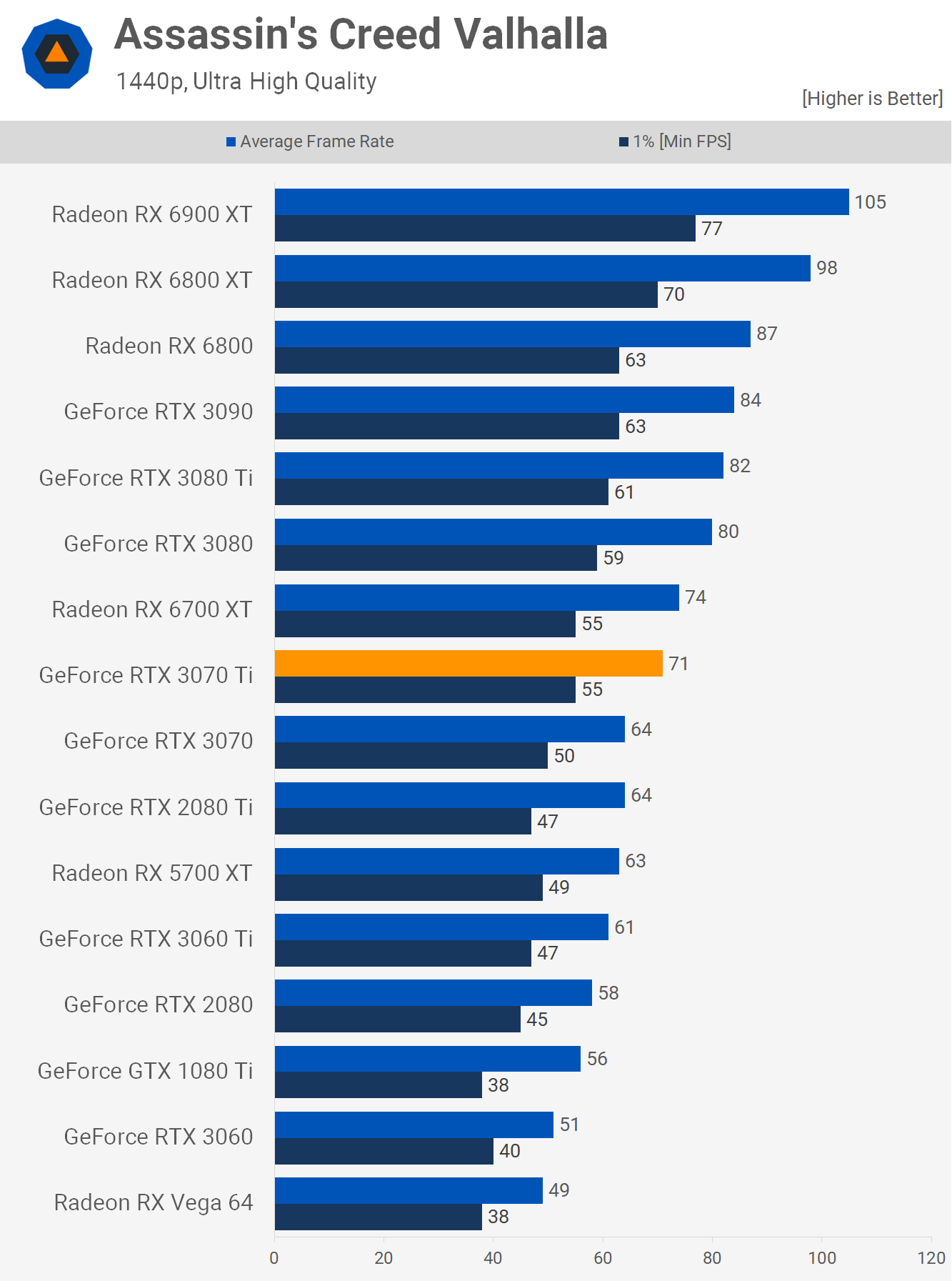
Starting time up we've got Assassinator's Creed Valhalla. This AMD sponsored title heavily favors Radeon GPUs and for some reason Nvidia has been unable to optimize their hardware for this game. Every bit a outcome the 3070 Ti is 18% slower than the 6800 and 28% slower than the 6800 XT, which is a massive performance difference.
When compared to the RTX 3070, it's 11% faster, which is to be expected given the specifications.
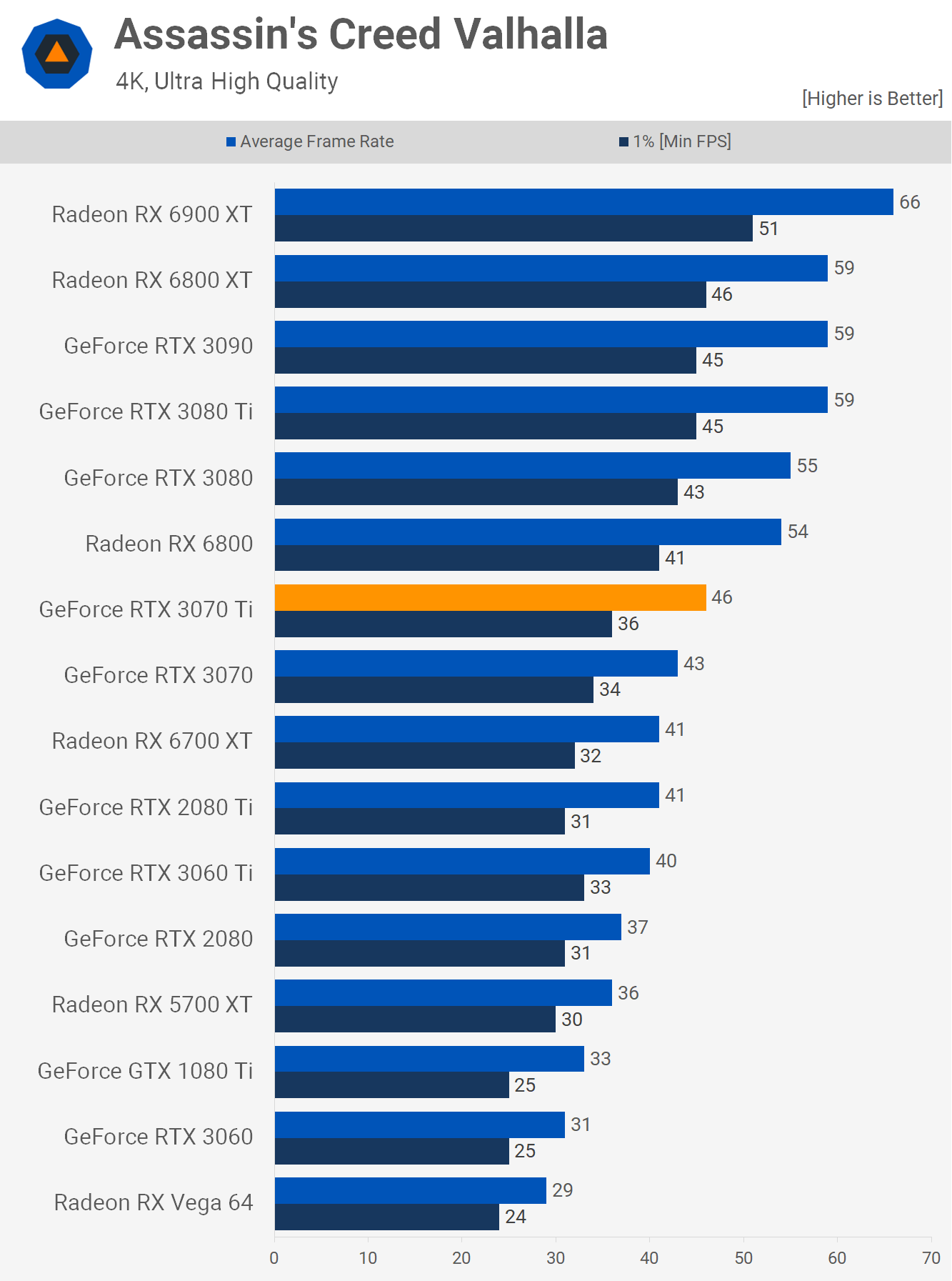
Nvidia'southward 2xFP32 blueprint does work better at 4K and as a result the 3070 Ti is now xv% slower than the 6800 and 22% slower than the 6800 XT. Withal large margins, simply smaller than what was seen at 1440p. Unfortunately the additional retentivity bandwidth didn't help the 3070 Ti at 4K as information technology was simply vii% faster than the 3070. Single-digit gains aren't impressive for a 20% increase in MSRP.
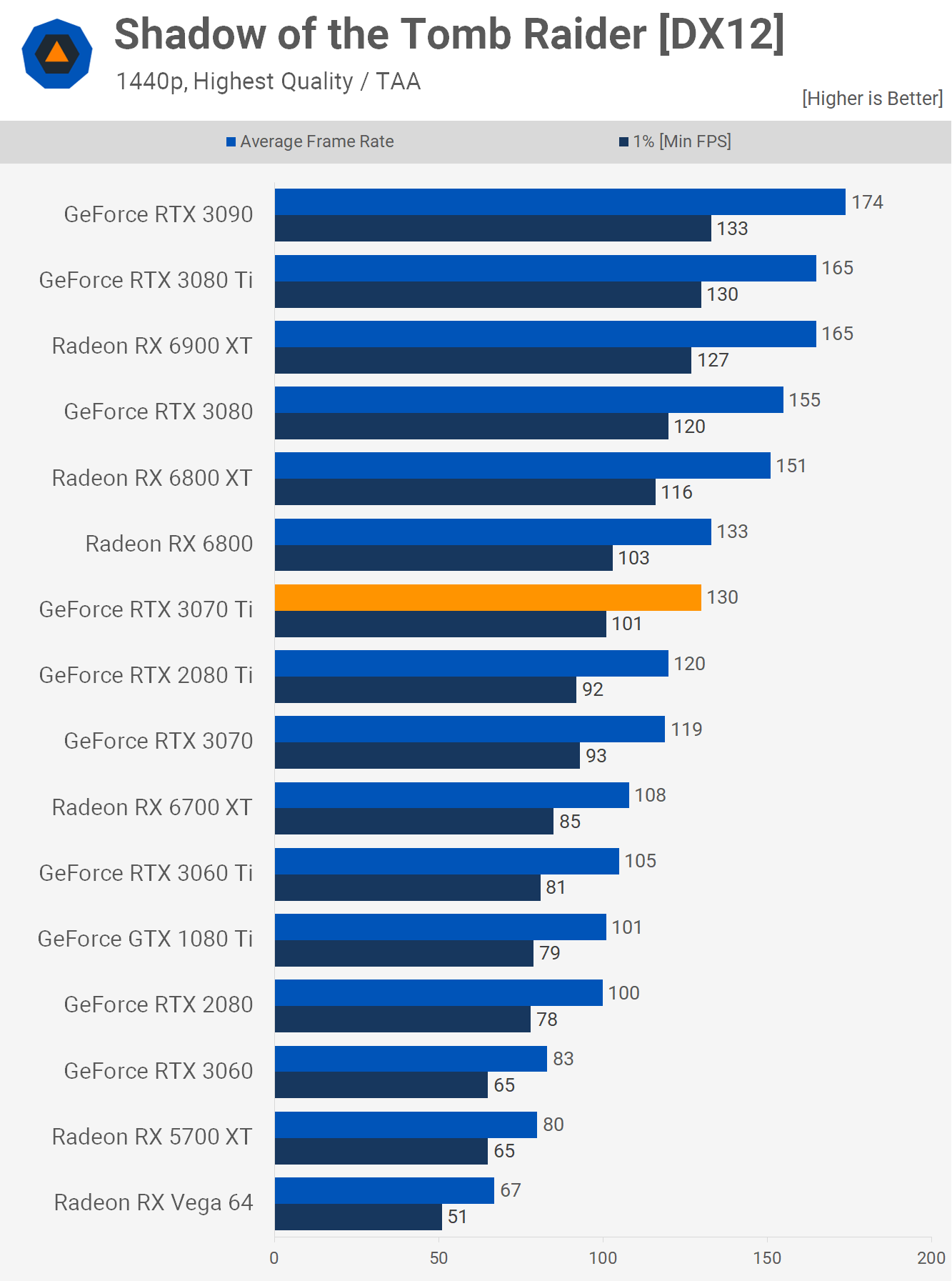
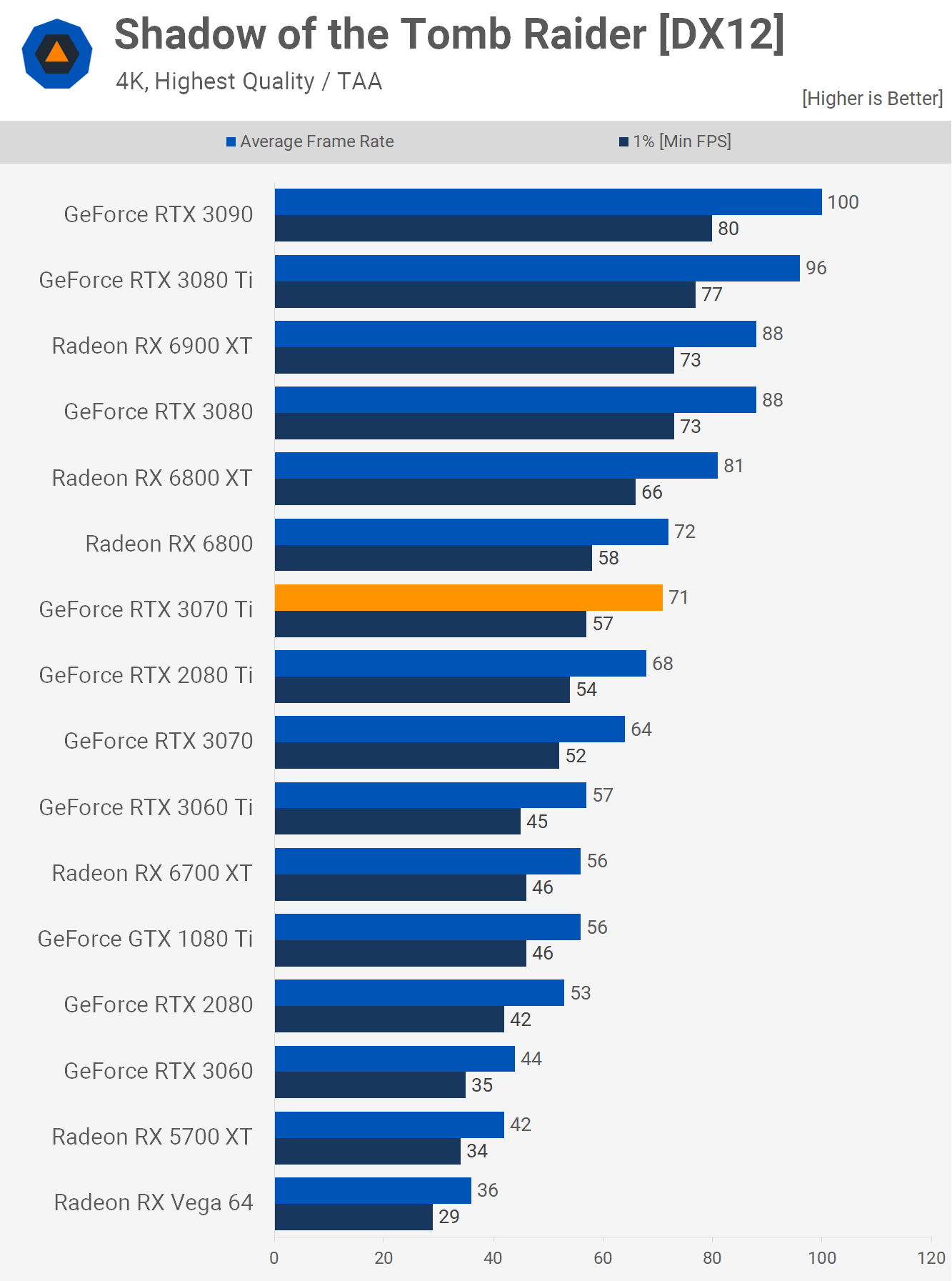
Shadow of the Tomb Raider is sponsored by Nvidia, though I consider this to be a neutral title, at least for rasterization performance which is what we're looking at here. The RTX 3070 Ti matched the RX 6800 with 130 fps on average at 1440p, making it 14% slower than the 6800 XT, which isn't bad given information technology's 8% cheaper, though it does only feature one-half the VRAM.
When compared to the 3070, we're looking at single digit gains. This time the 3070 Ti was 9% faster. The 4K margins expect similar: the 3070 Ti matched the RX 6800, and it was 12% slower than the 6800 XT. When compared to the original RTX 3070 it was eleven% faster, which is the biggest margin we've seen and so far, certainly not amazing and not nearly plenty to justify the 20% increase in MSRP.
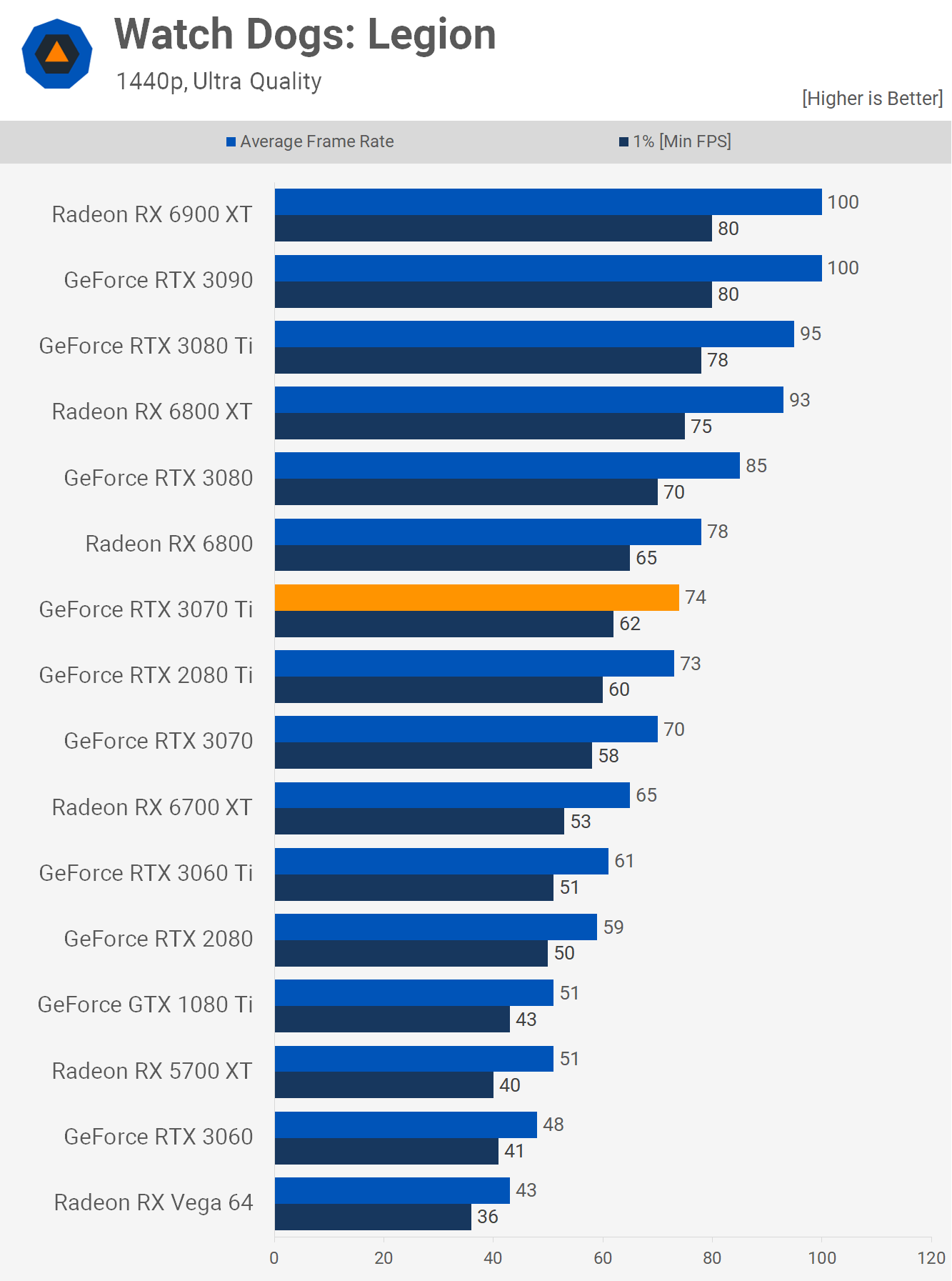
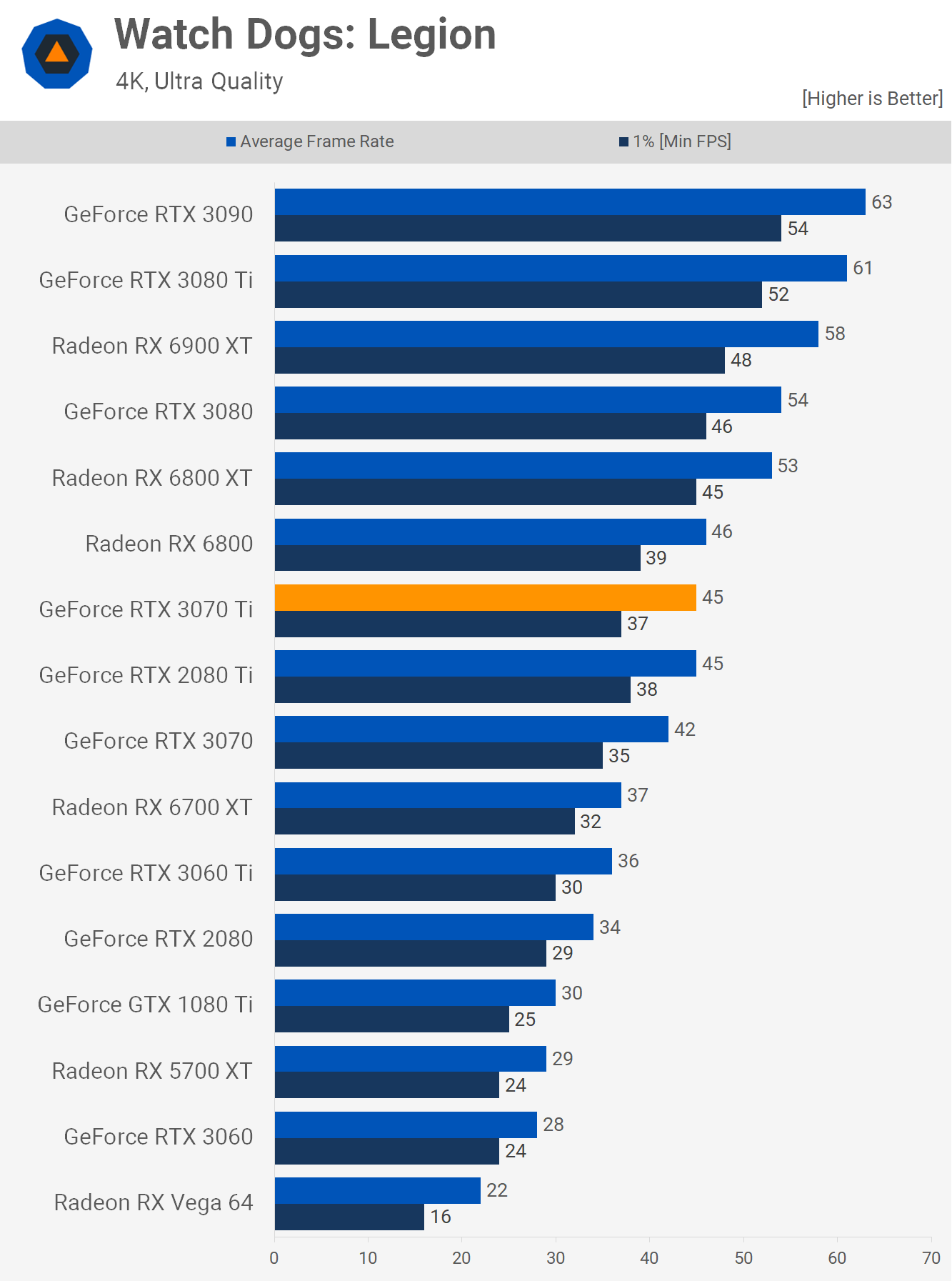
Watch Dogs: Legion is another Nvidia sponsored title that supports ray tracing and DLSS, simply it works well on both AMD and Nvidia hardware. The RTX 3070 Ti is seen trailing the RX 6800 past a v% margin, making information technology a whopping 20% slower than the 6800 XT. We're besides looking at a tiny 4% boost over the 3070.
Moving up to 4K sees the 3070 Ti lucifer the RX 6800, though information technology was barely whatever faster than the standard 3070.
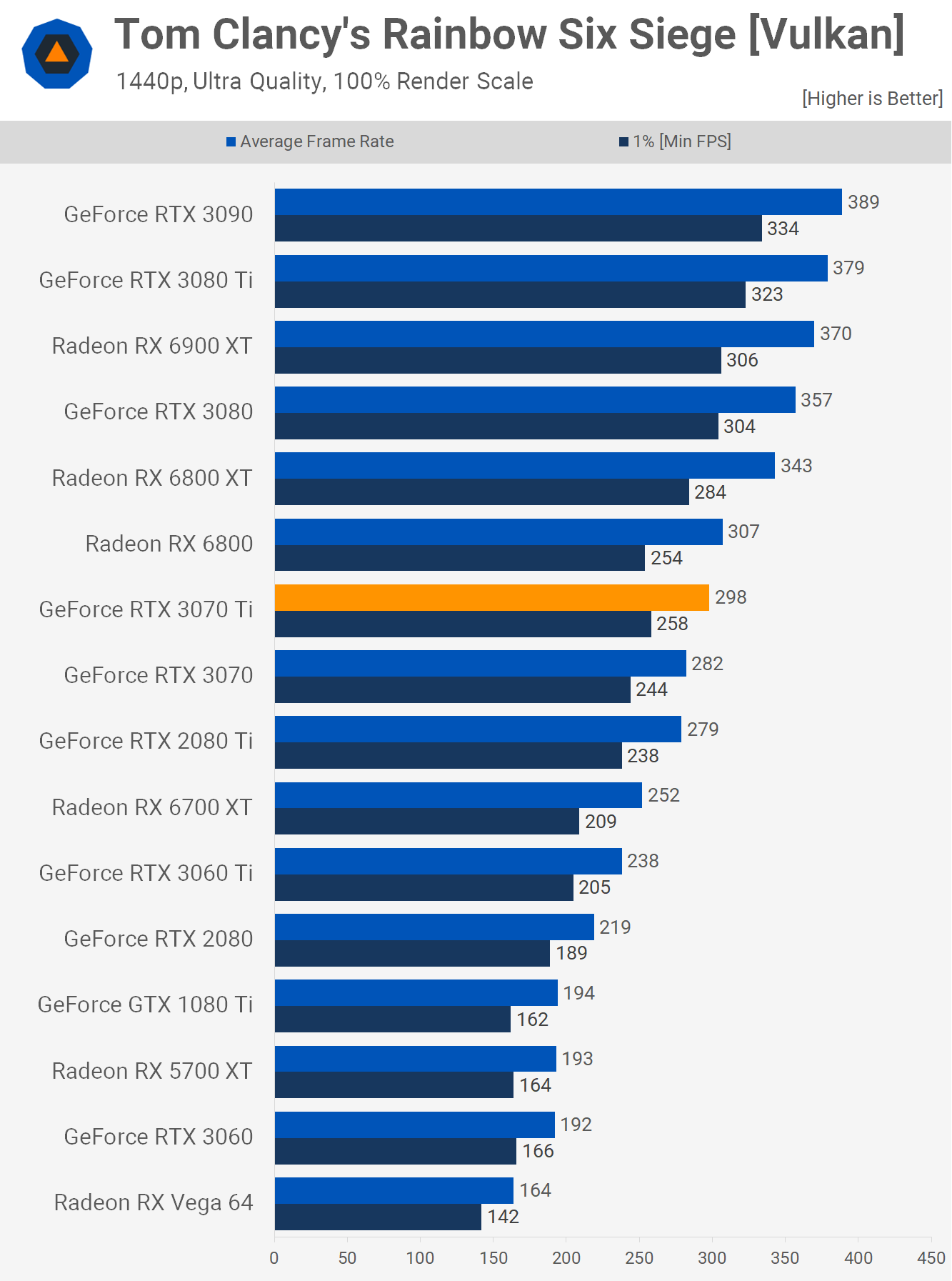
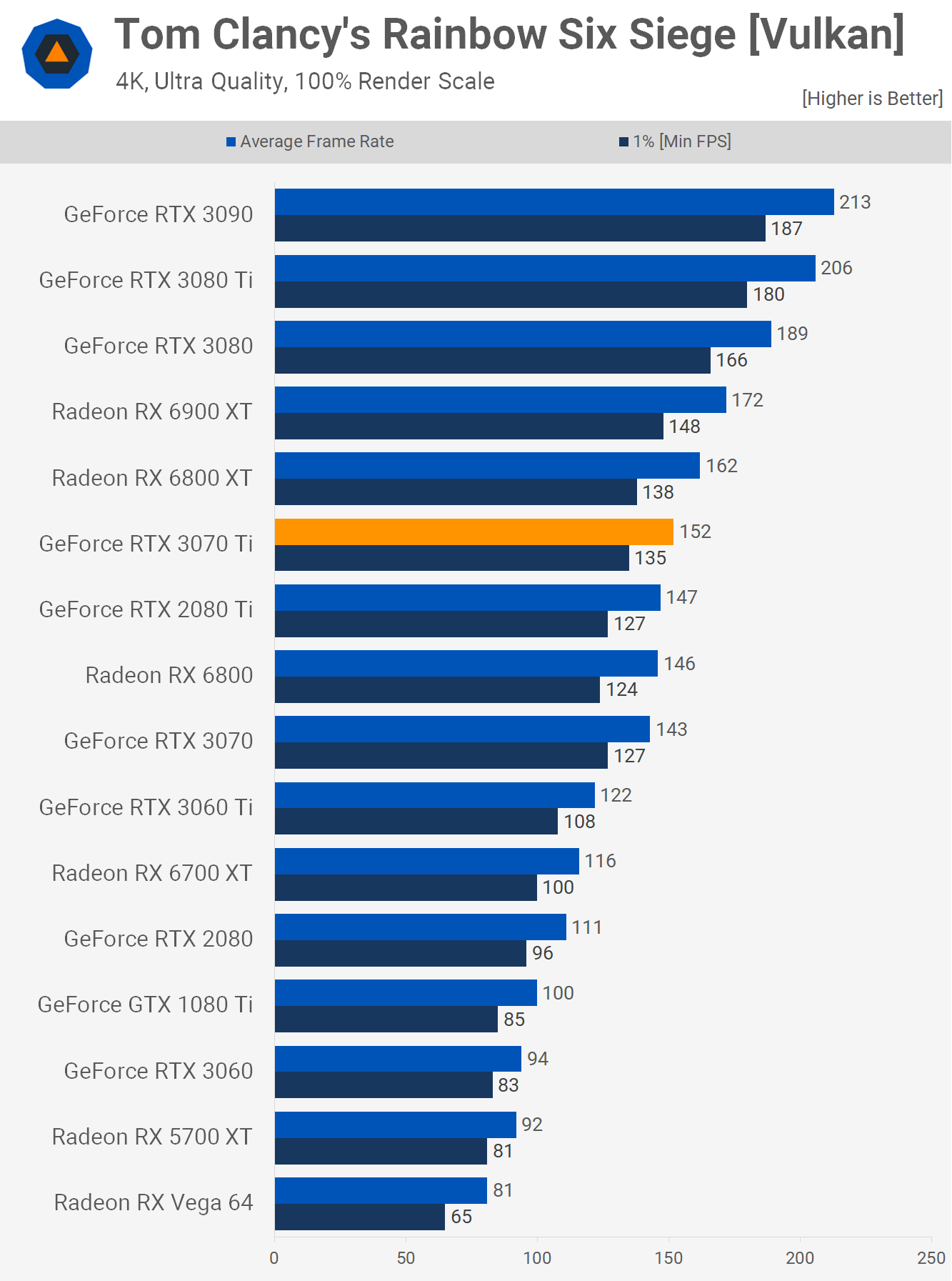
At that place are probably much cheaper GPUs you could apply for playing competitive titles, but if you want ~300 fps using the maximum visual quality settings, the 3070 Ti volition suffice as it delivered RX 6800-similar performance, making information technology only 13% slower than the 6800 XT, but also 6% faster than the 3070.
The 4K frame rates are a lot less ridiculous every bit the 3070 Ti was good for 152 fps on boilerplate, placing it ahead of the RX 6800 by a small 4% margin.
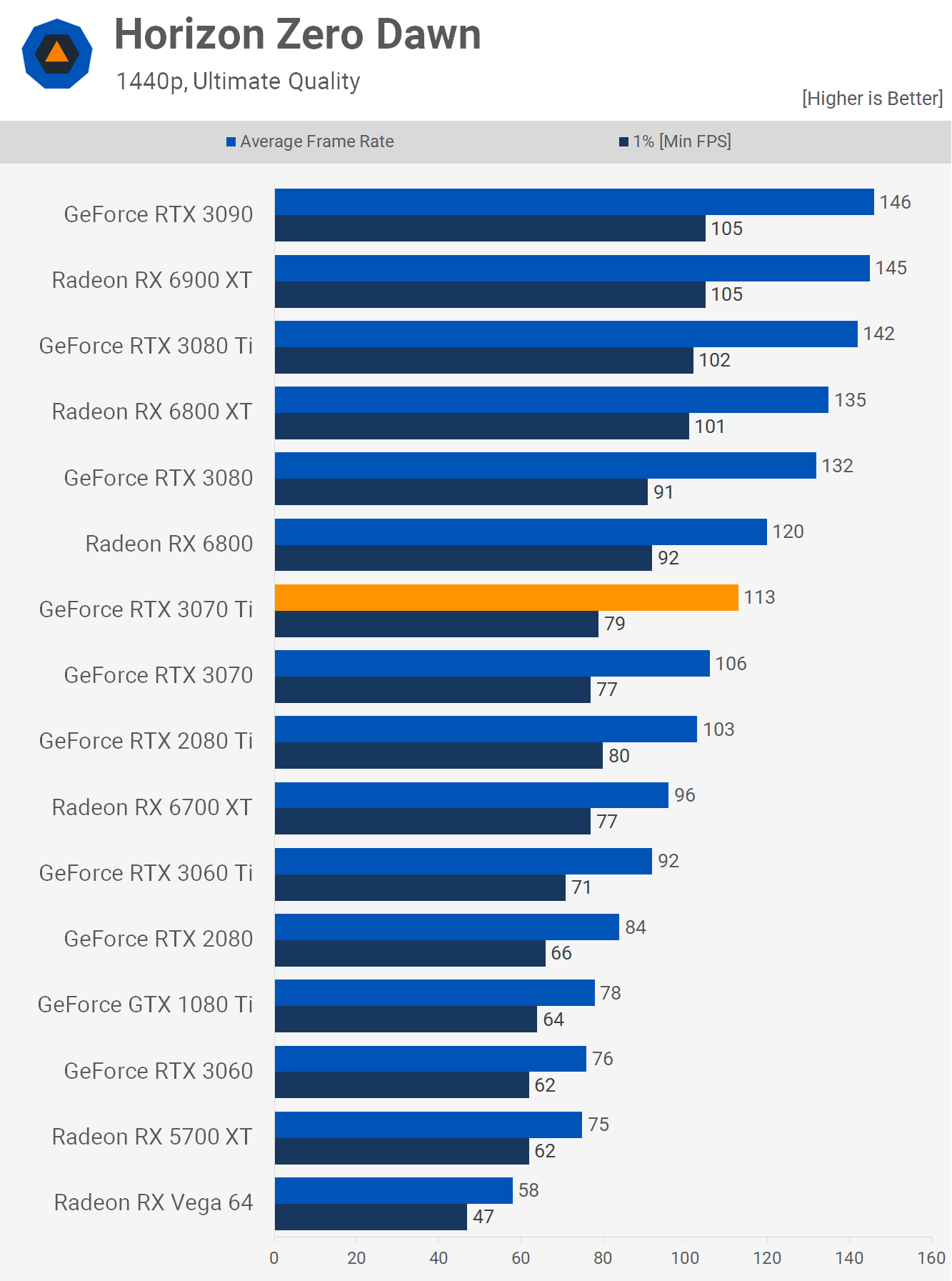
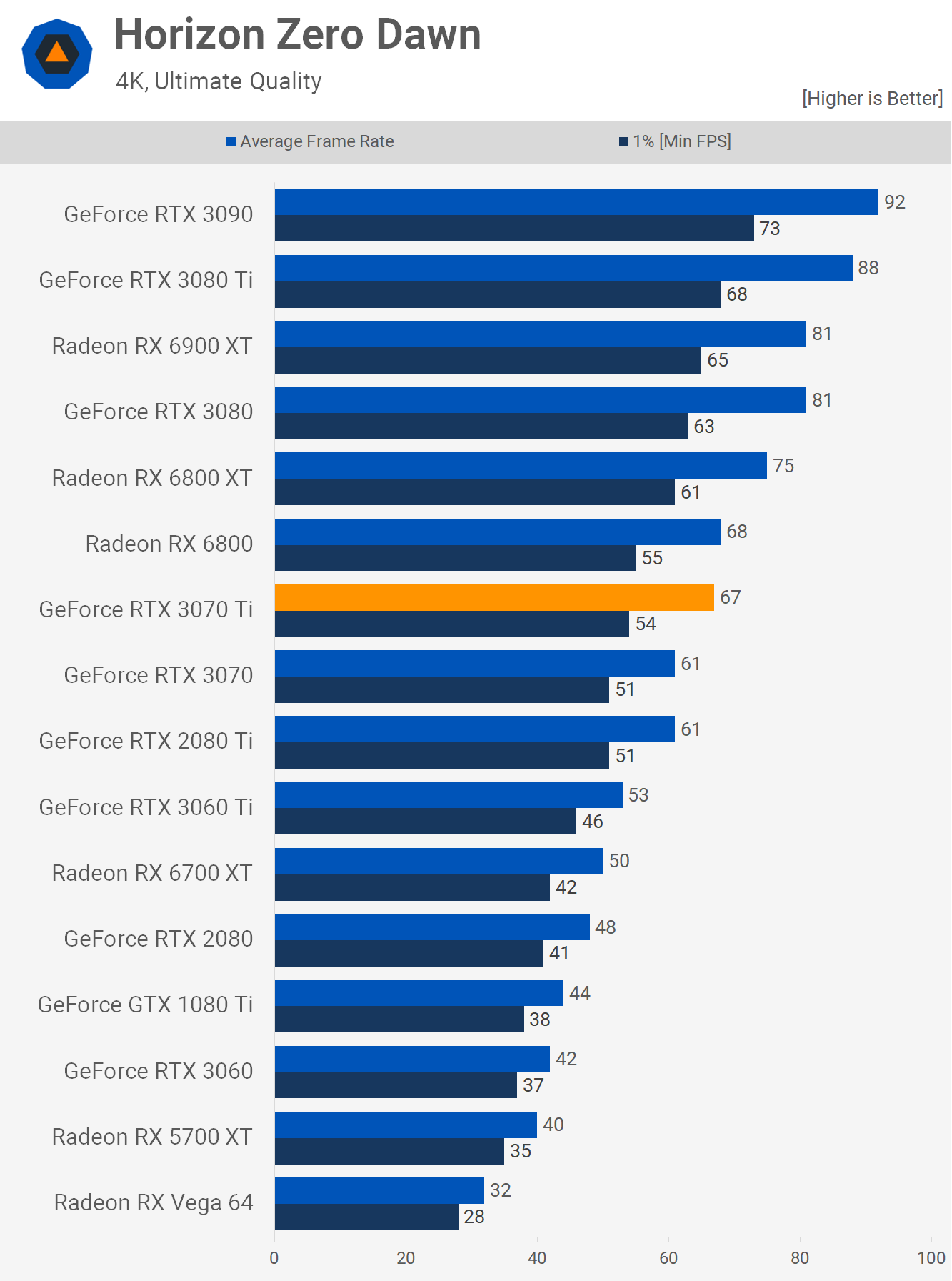
Next up we have Horizon Nix Dawn and once once again the 3070 Ti is slower than the RX 6800, this time falling backside past six% margin and that meant it was xvi% slower than the 6800 XT. Not a terrible result, but it was only 7% faster than the 3070, then you have to wonder what the point is.
At 4K nosotros do see the 3070 Ti beat the original 3070 past a x% margin, but that hardly offsets the 20% increase in cost.
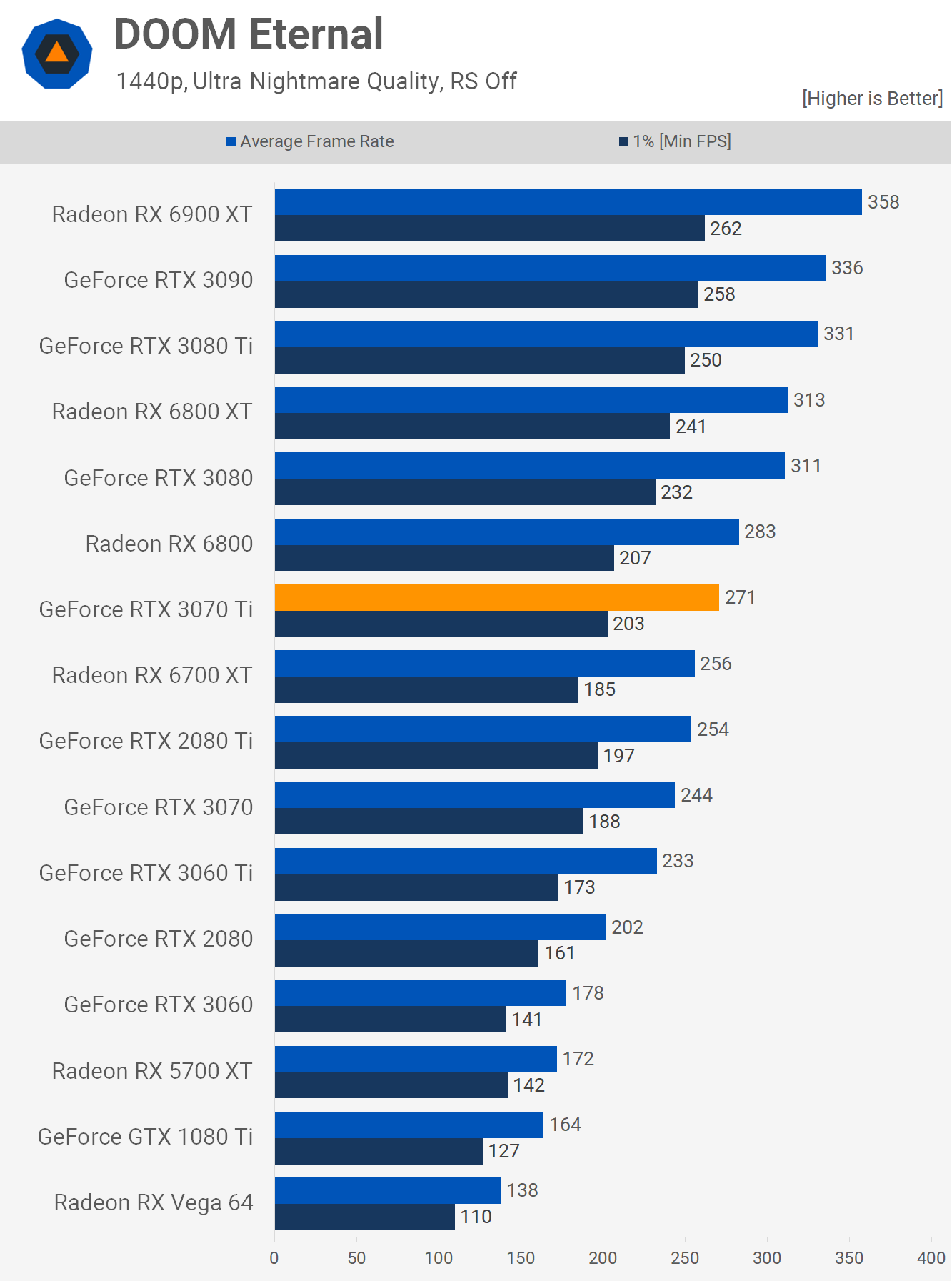
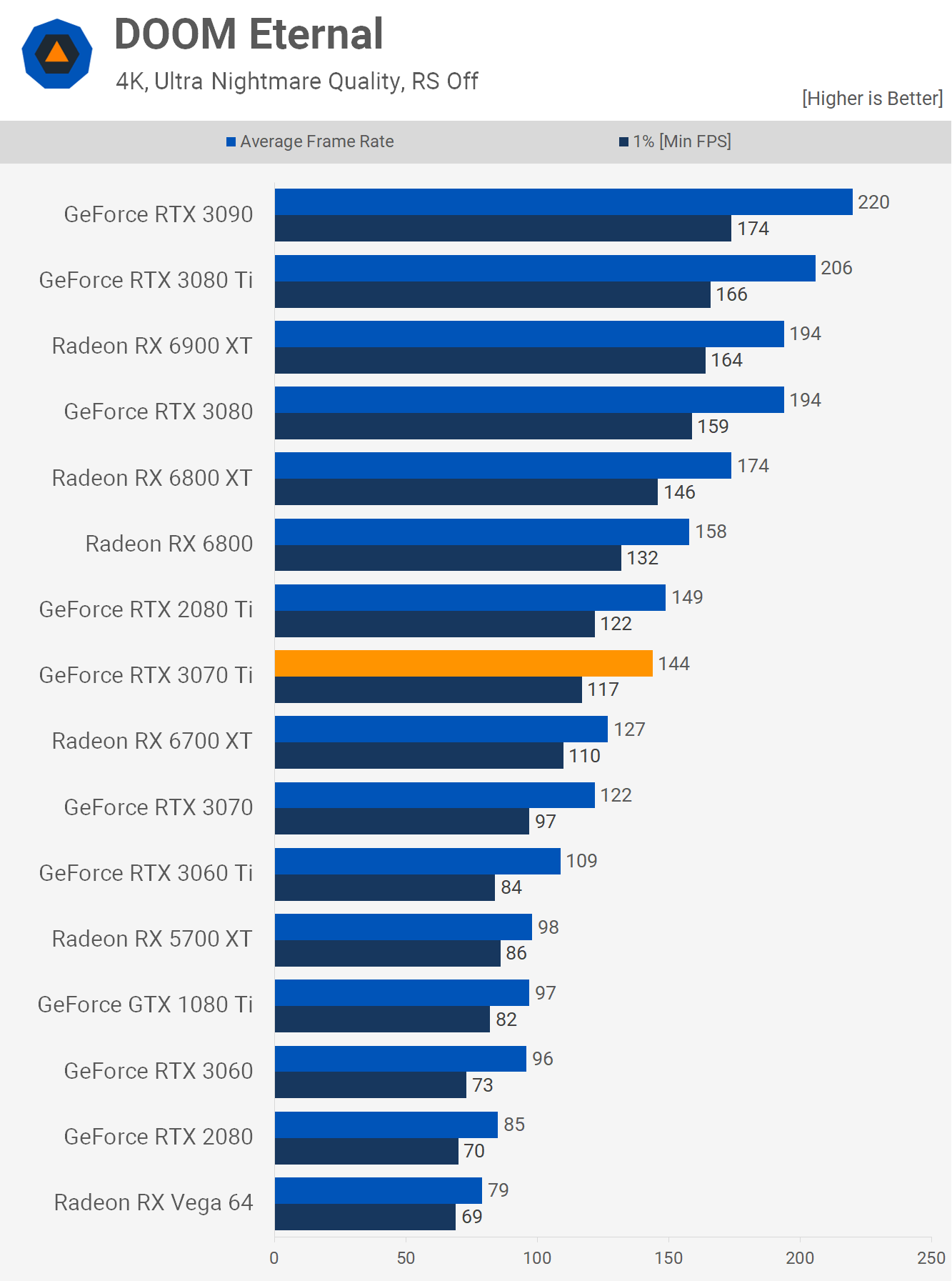
Testing with Doom Eternal reveals similar margins betwixt the 3070 Ti and RX 6800, though the cheaper Radeon GPU was still four% faster and the 6800 XT was 15% faster.
Now at 4K we run across something interesting. It's worth noting that at 4K, using the ultra nightmare quality settings, Doom Eternal calls for 9GB of VRAM and that's not allocation simply actual memory usage. Every bit such, GPUs with 8GB or less VRAM struggle more at 4K relative to models with more than memory. At 1440p the game just calls for vii GB of VRAM.
For case, the RTX 3080 is 27% faster than the 3070 at 1440p, but at 4K that margin more than than doubles to 59%. The 3070 Ti has the same memory capacity as the 3070, but bandwidth has been increased by 36% and that really helps here. At 1440p the 3070 Ti was eleven% faster than the 3070, merely at 4K it's xviii% faster.
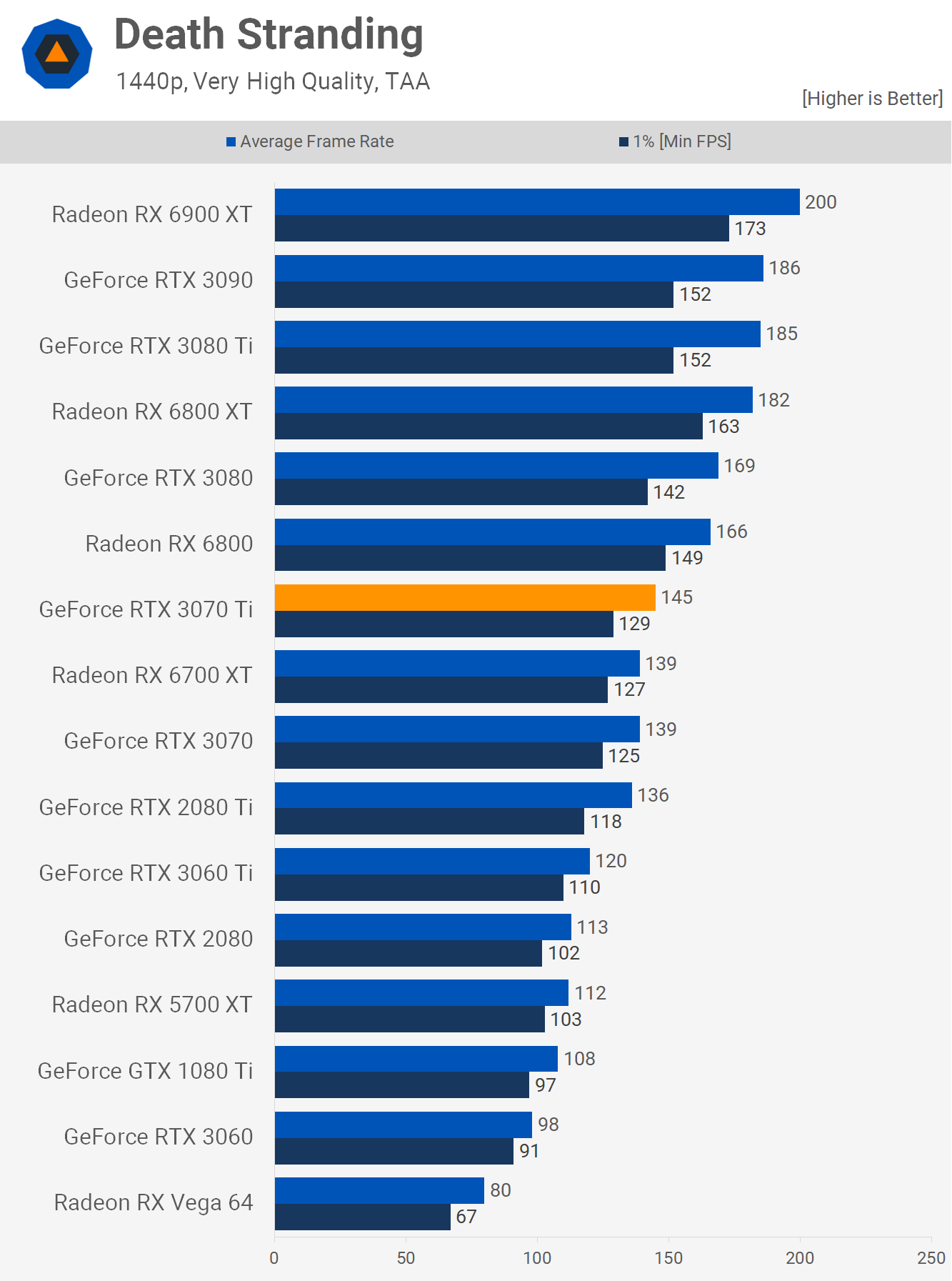
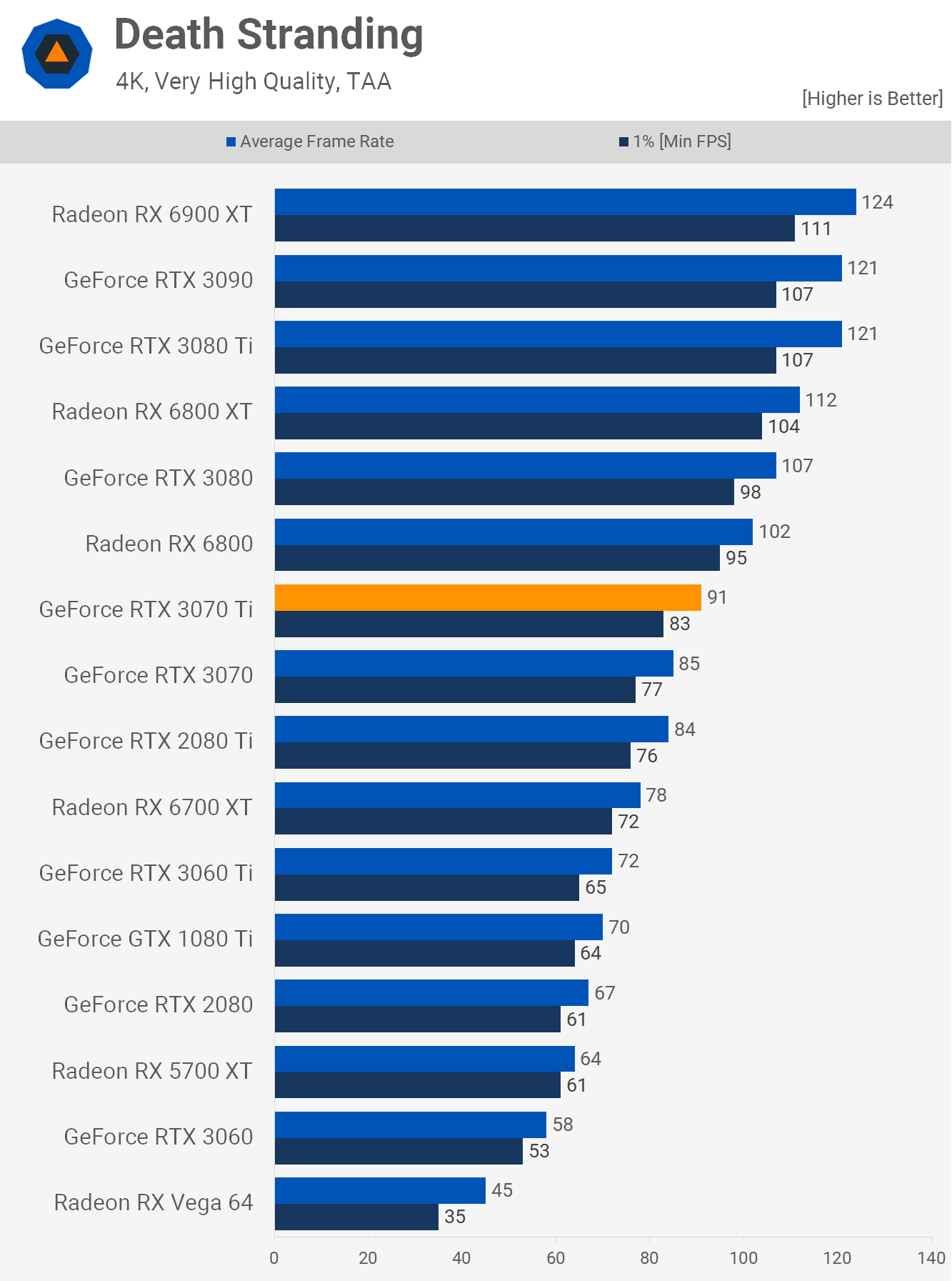
Moving on to the Death Stranding testing, nosotros find some particularly disappointing results for the RTX 3070 Ti. Here information technology was xiii% slower than the RX 6800 and 20% slower than the 6800 XT. Just nigh disappointing of all was the margin to the 3070, here it was just 4% faster.
That margin does increase at 4K, but even here the 3070 Ti was just 7% faster than the 3070 and that meant it was still 11% slower than the RX 6800 and nineteen% slower than the 6800 XT.
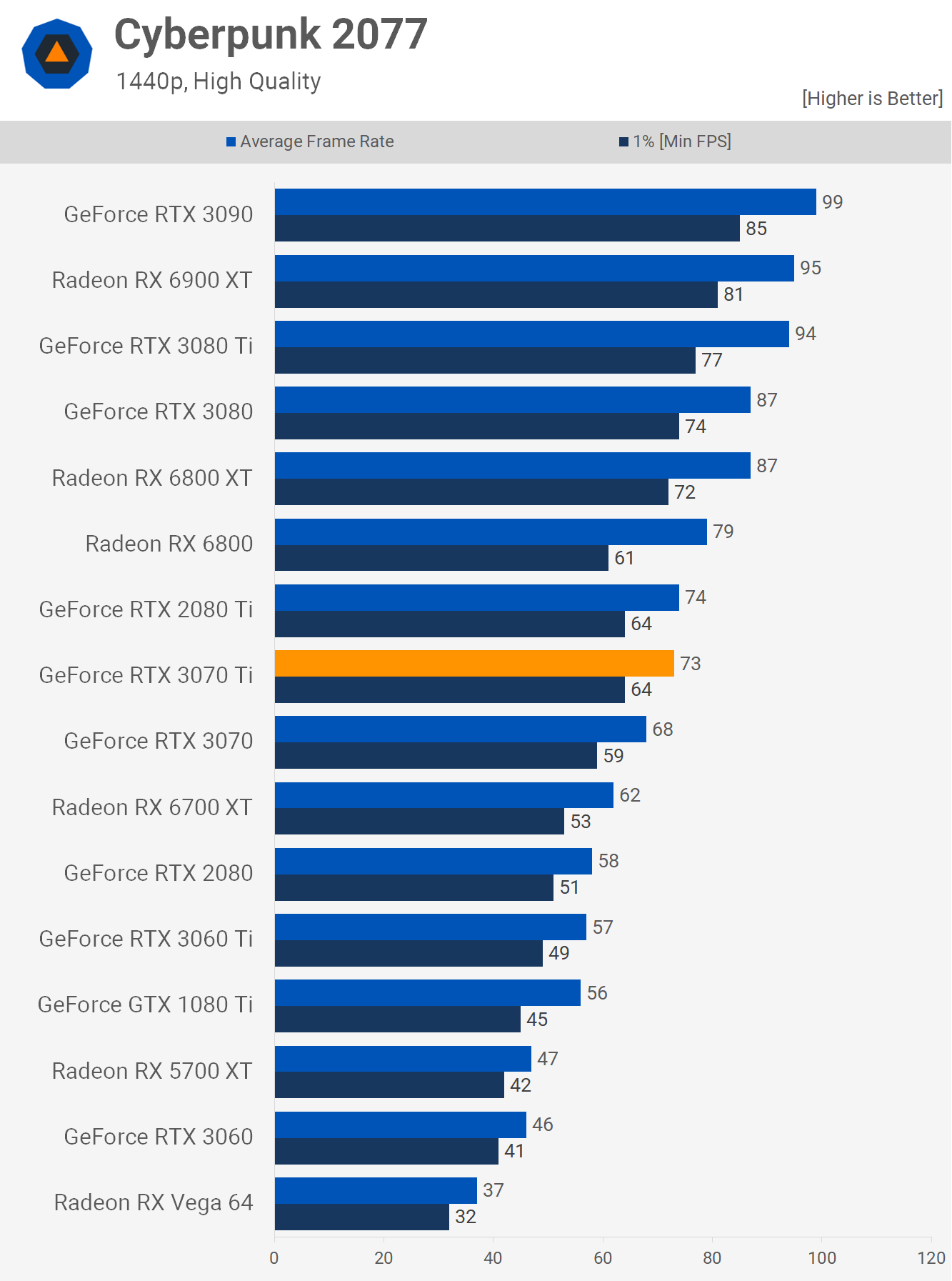
In Cyberpunk 2077 the 3070 Ti isn't overly impressive, 73 fps on average meant it was just seven% faster than the original 3070, and 8% slower than the RX 6800.
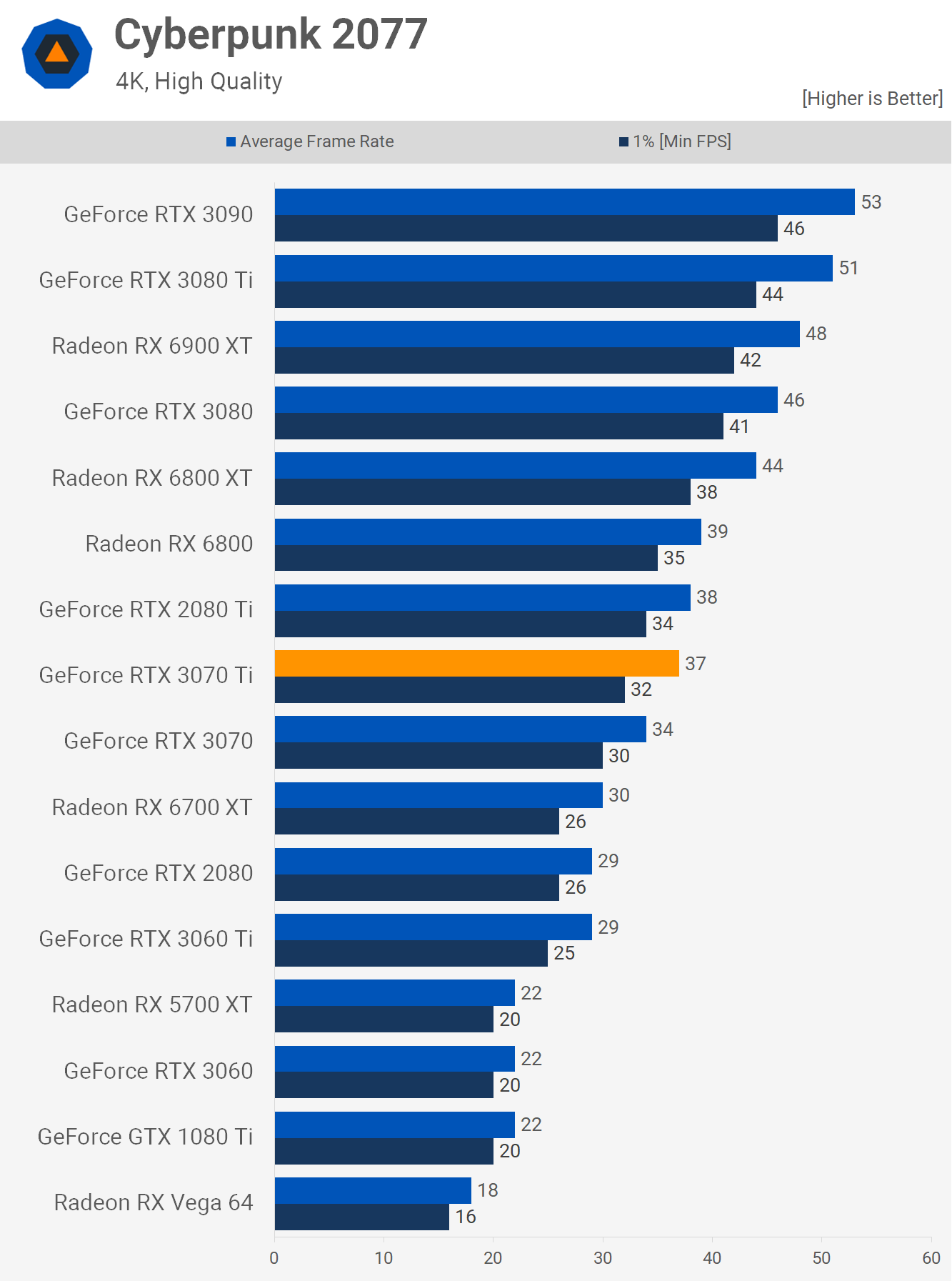
Then at 4K we're looking at just 37 fps on average using the high preset, not ultra. That's a 9% boost over the 3070 and 5% slower than the RX 6800 or 16% slower than the 6800 XT.
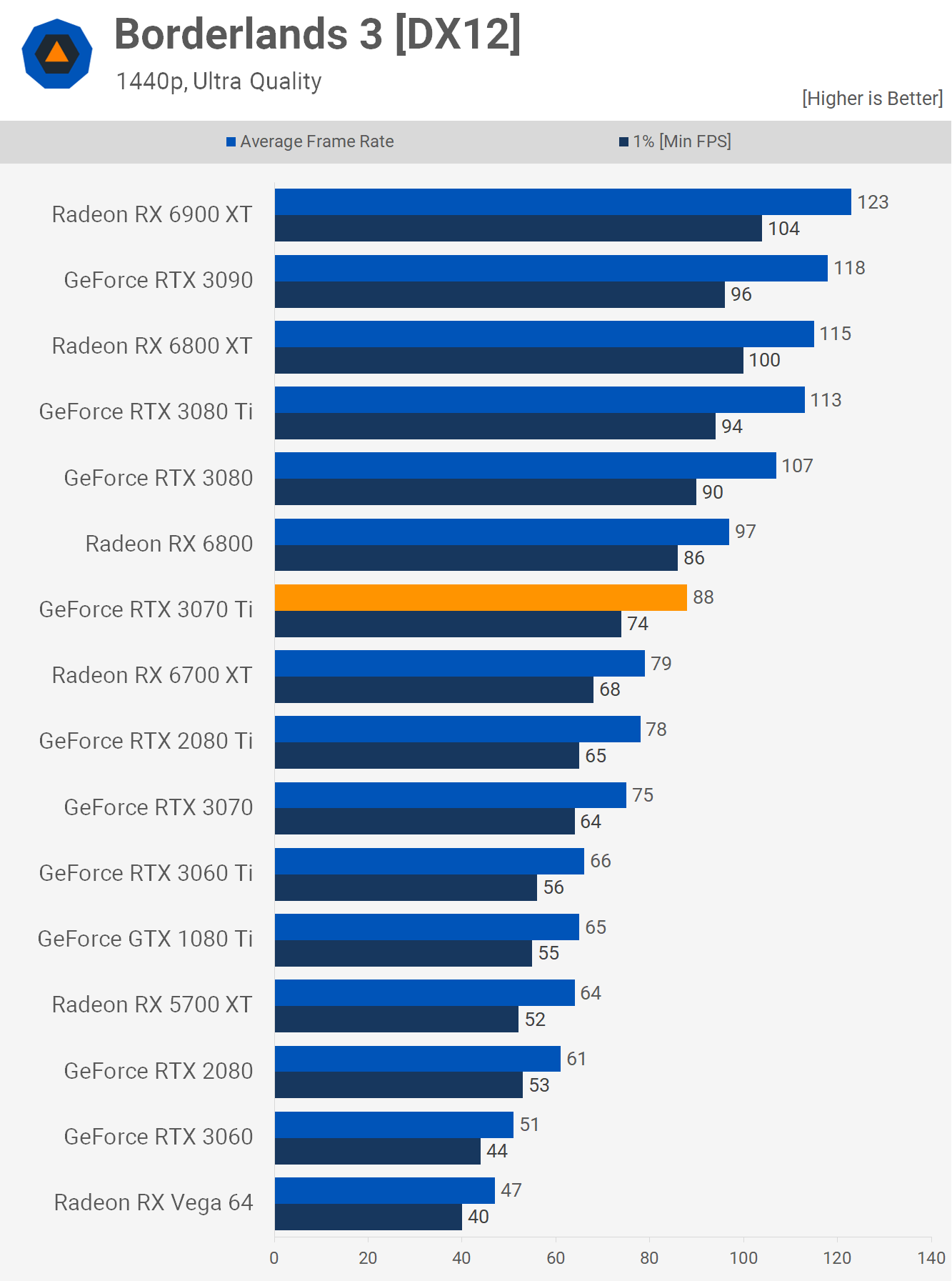
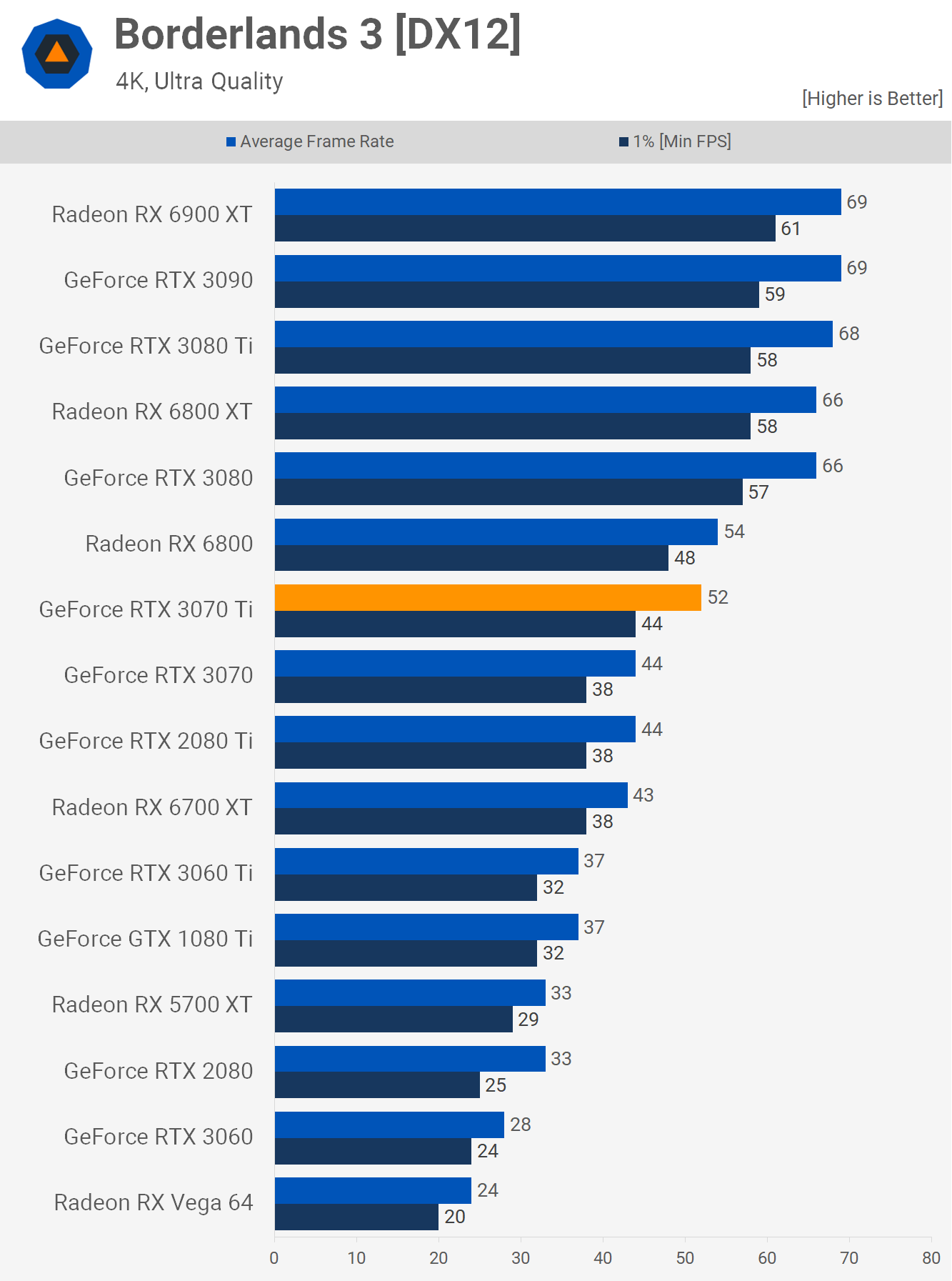
Borderlands 3 is AMD sponsored though like Shadow of the Tomb Raider I consider it to be a neutral title for testing. The results accept the RTX 3070 Ti performing 9% slower than the RX 6800 and 23% slower than the 6800 XT. That said, the results are interesting as the 3070 Ti was 17% faster than the 3070 and that's a much larger performance divergence than we've seen in pretty much every other title tested so far.
A similarly large margin was seen at 4K, where the 3070 Ti was 18% faster than the original 3070, rendering 52 fps on boilerplate, enough to match the RX 6800.
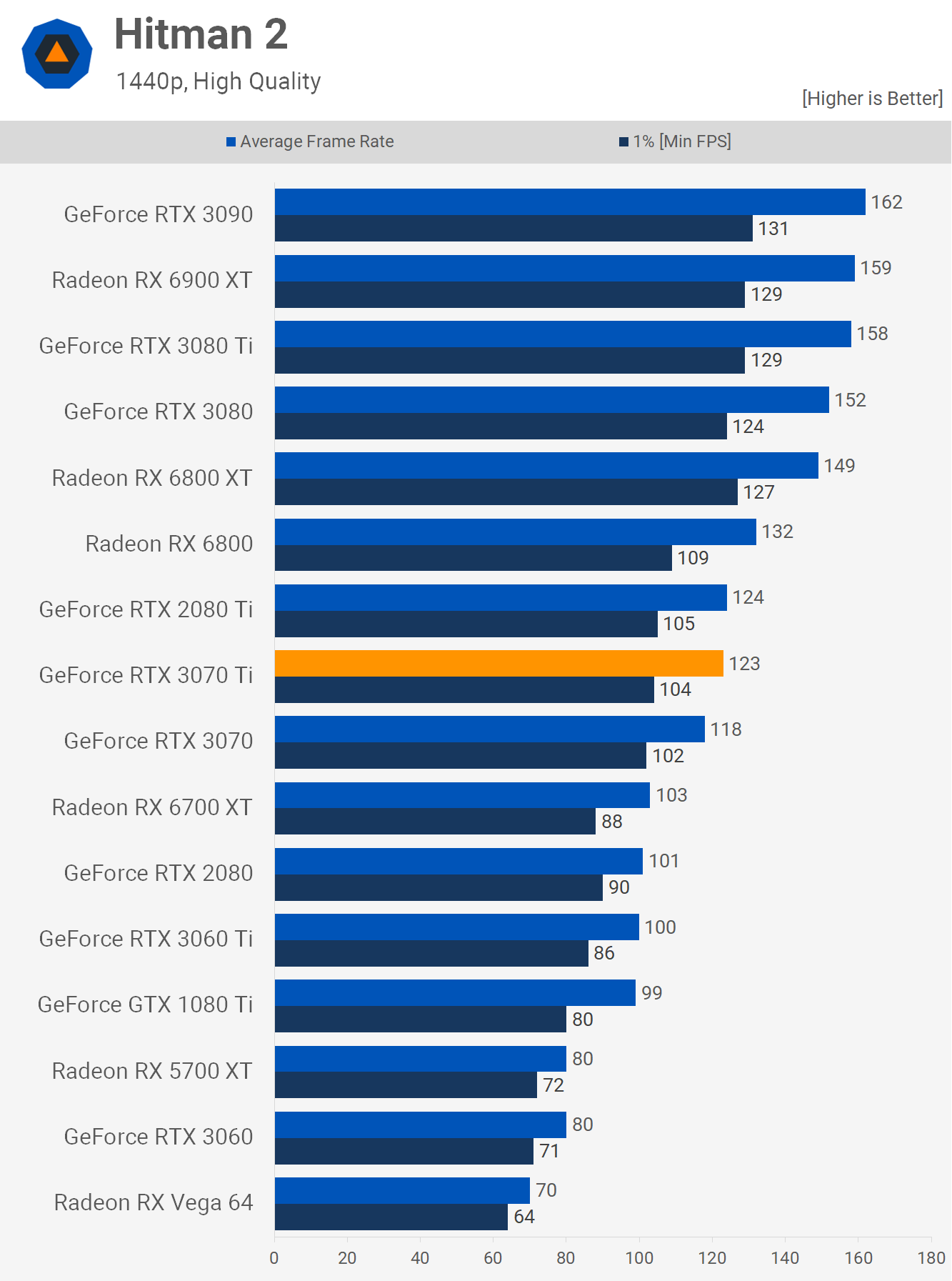
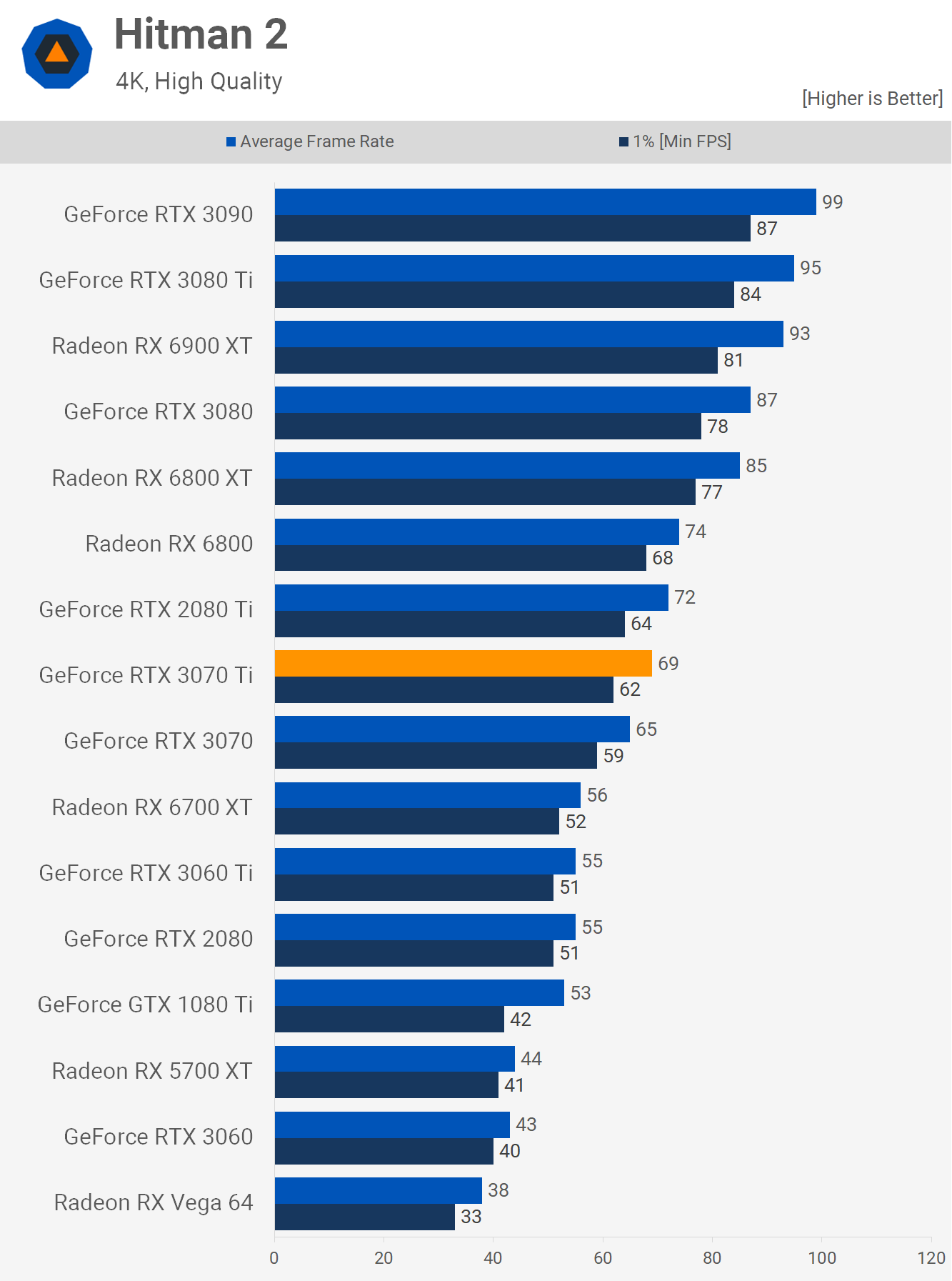
Hitman ii provides u.s. with fairly typical results with what nosotros've seen thus far. The 3070 Ti was only four% faster than the 3070 at 1440p and that meant it was seven% slower than the RX 6800 and 17% slower than the 6800 XT. The 4K results are more of the same: the 3070 Ti was six% faster than the 3070, seven% slower than the RX 6800 and xviii% slower than the 6800 XT.
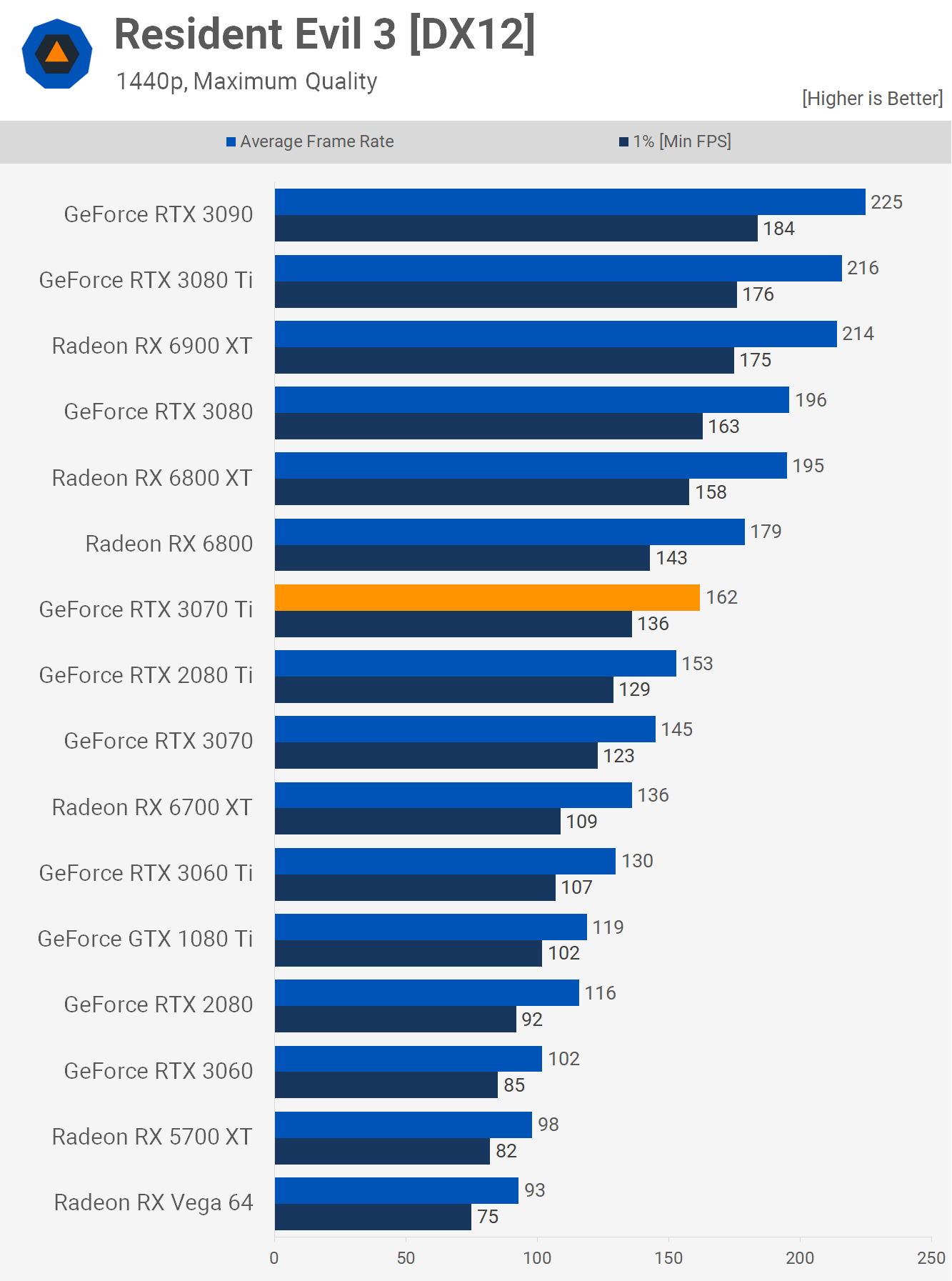
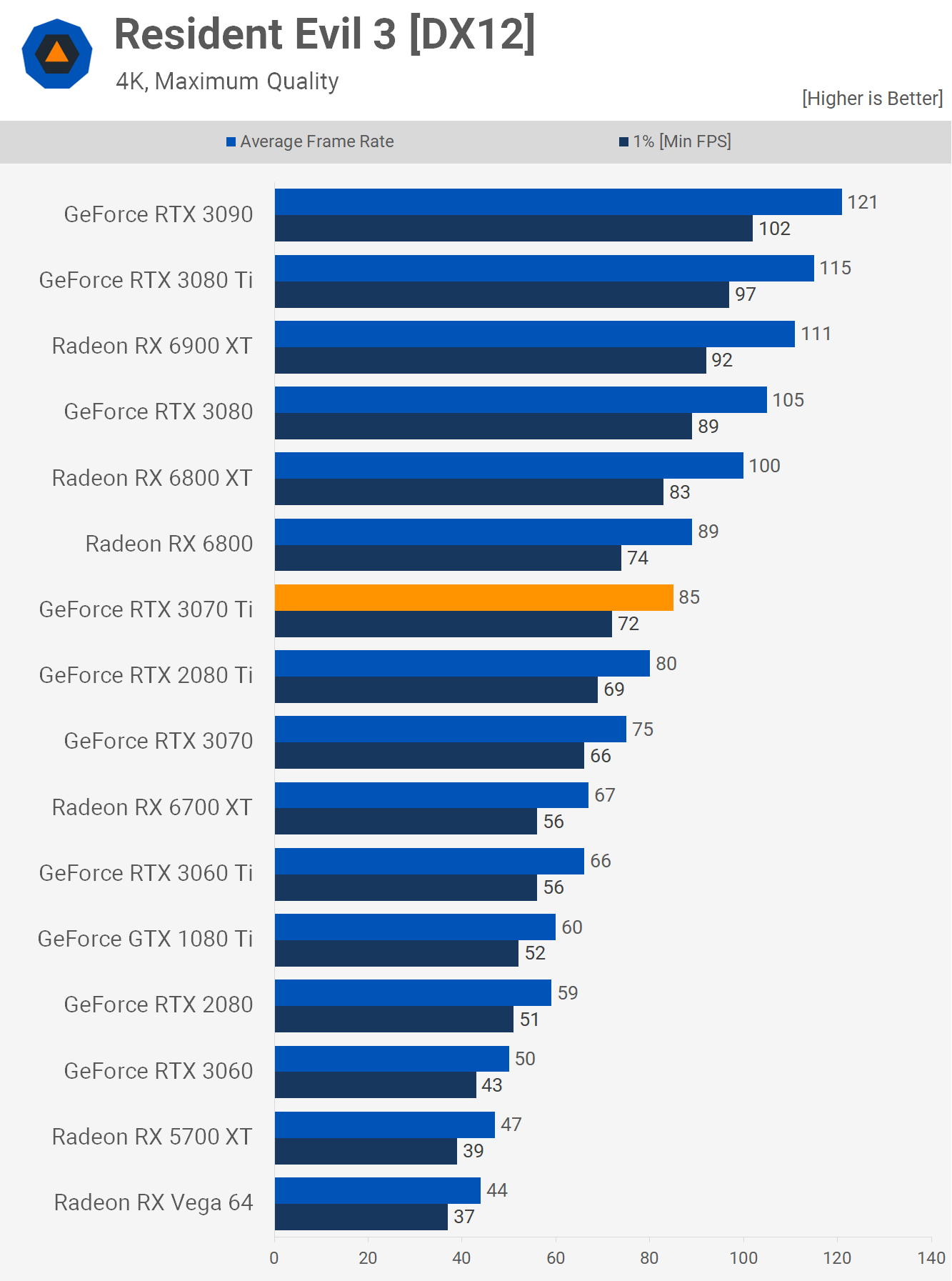
Resident Evil 3 is yet some other title where the 3070 Ti loses out to the Radeon contest. Although it was 12% faster than the 3070, it's 9% slower than the cheaper RX 6800 and 17% slower than the 6800 XT. Figures better a little at 4K but non enough to overcome the Radeons.
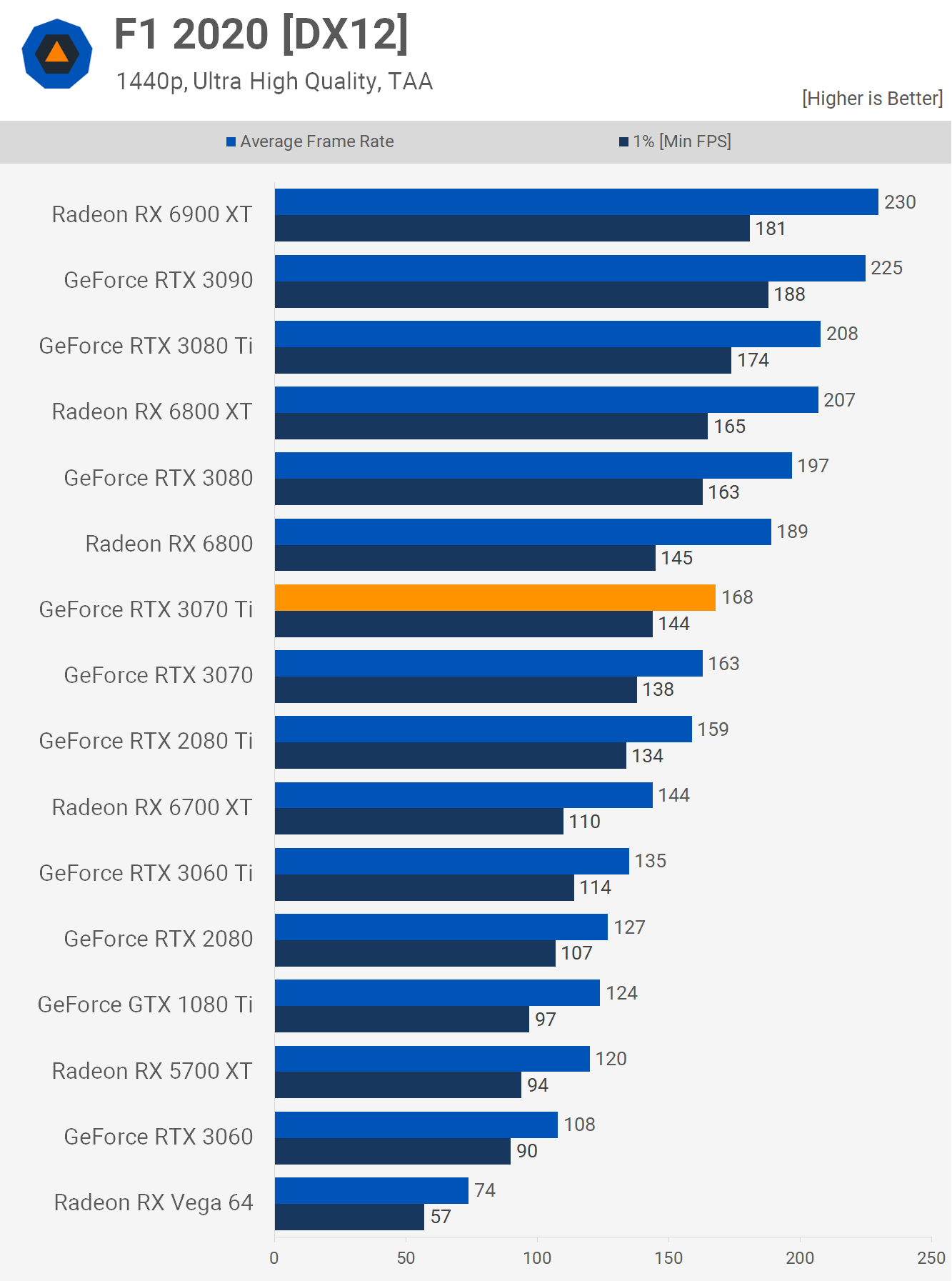
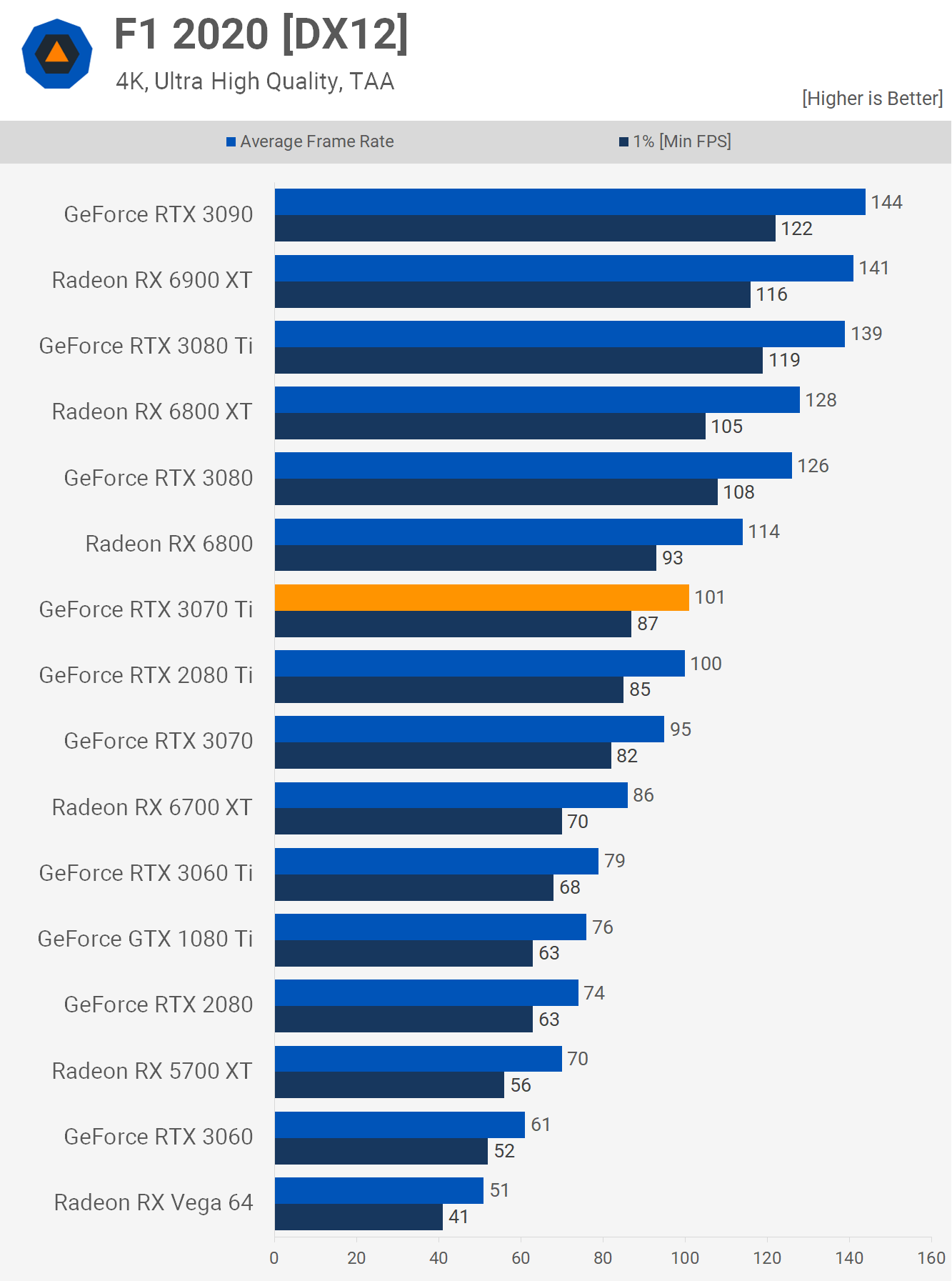
F1 2022 makes us stop on a weak note for the RTX 3070 Ti. Nvidia's new $600 GPU is just 3% faster than the $500 version, and so information technology was 11% slower than the RX 6800 and nineteen% slower than the 6800 XT. Fifty-fifty at 4K the 3070 Ti receives a dusting, losing to the RX 6800 by an 11% margin and the 6800 XT by a 21% margin.
Average Performance
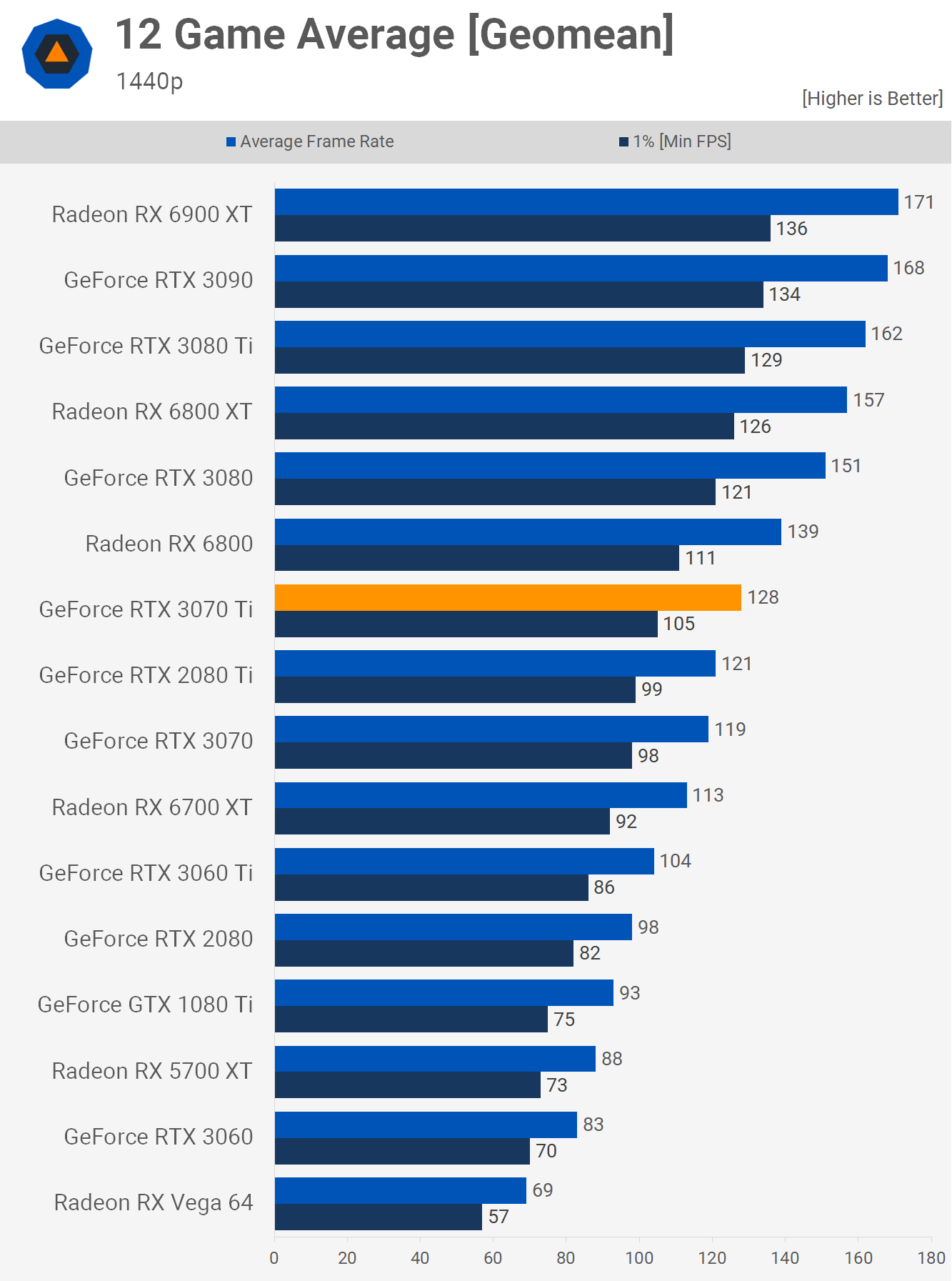
Here's a summary of all the previous results with no surprises to exist found. At 1440p, the RTX 3070 Ti is on boilerplate 8% slower than the RX 6800, and 18% slower than the 6800 XT, while beating the original RTX 3070 past 8%.
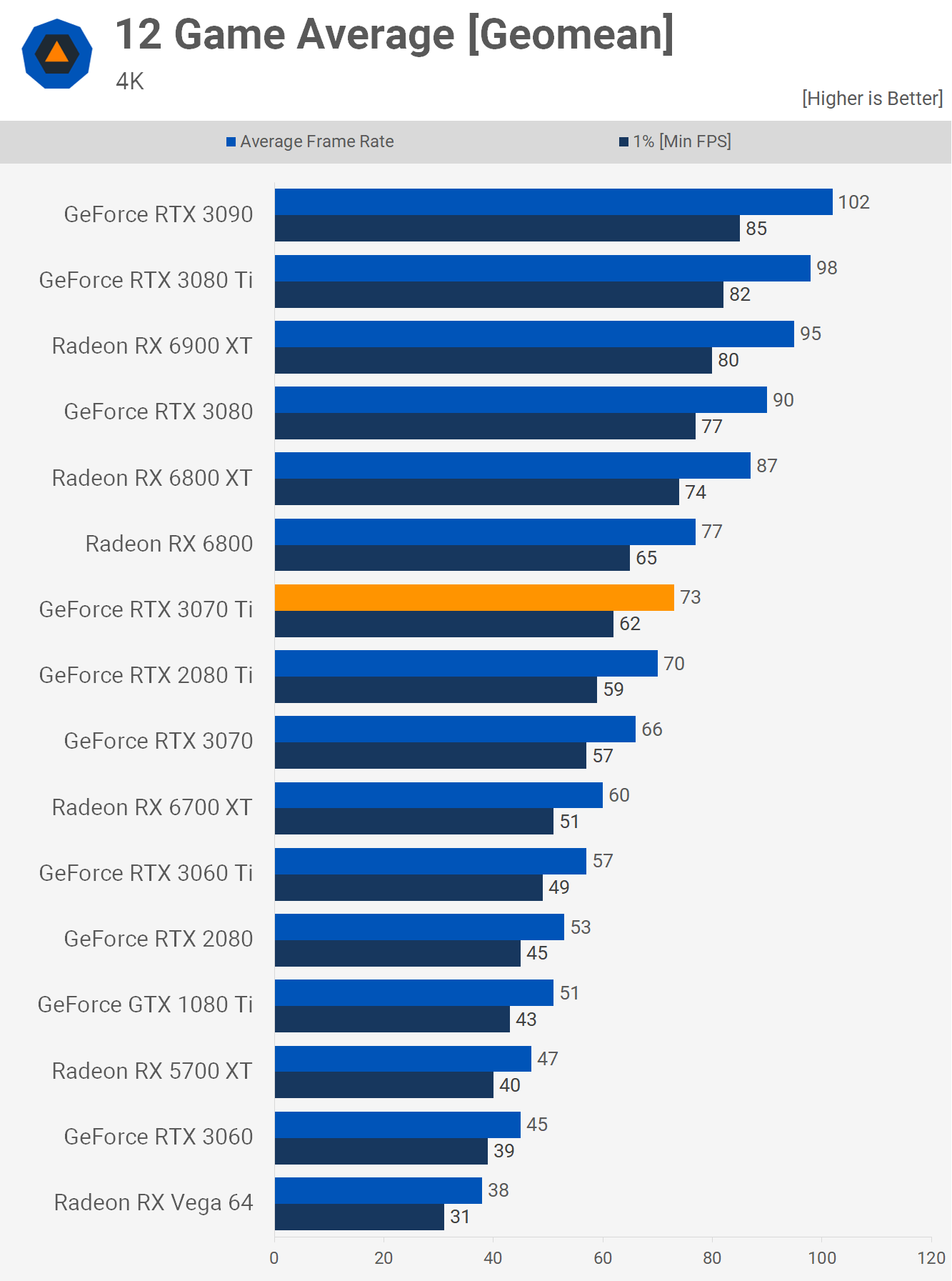
At least at 4K the 3070 Ti is able to pull out a double-digit margin over the 3070, if only only, chirapsia it past 11% on boilerplate. Overall it remains ~5% slower than the RX 6800 and xvi% slower than the 6800 XT.
Power Consumption
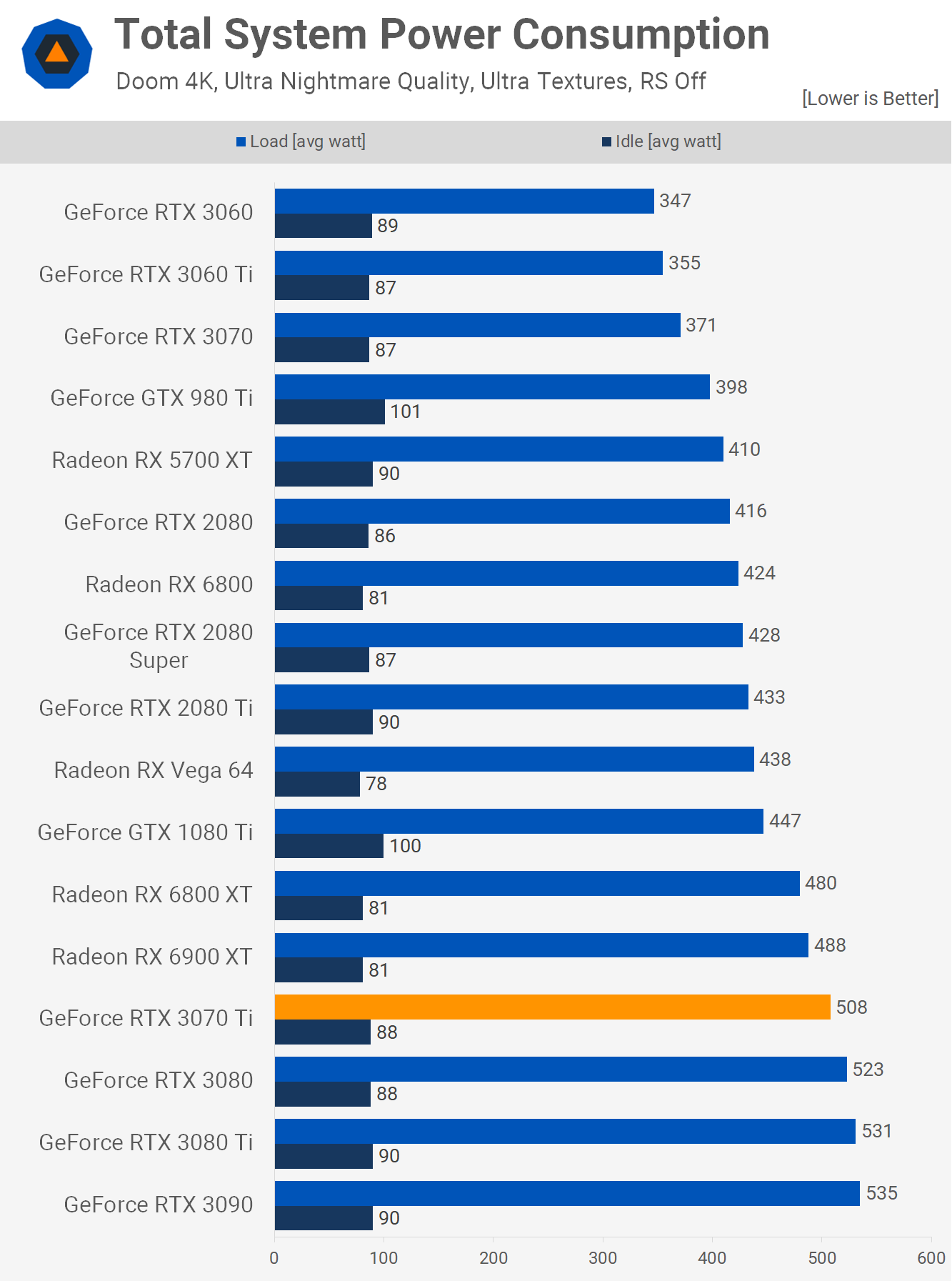
When it comes to ability consumption, the RTX 3070 Ti consumes significantly more power than the RX 6800, increasing full system usage by twenty%, and that's a significant increment when factoring in entire system usage.
GPU Epitomize, What Nosotros Learned
That'due south our look at the new GeForce RTX 3070 Ti, and at present information technology's time to make sense of it. But before nosotros exercise, here's a quick Ampere vs. RDNA2 epitomize of how we've called information technology so far...
In a mostly no-sense battle for gamers, between the GeForce RTX 3090 and Radeon RX 6900 XT, nosotros picked the RTX 3090 as the clear winner here as it's a no-compromise solution offering more than VRAM and better performance at 4K. If you lot accept money for the best and desire the best, the 3090 is at to the lowest degree that, the 6900 XT is a compromise and at $k makes less sense than the 3090 at $1500.

Next, nosotros have the battle between the RTX 3080 and RX 6800 XT. And again we went with the Nvidia GPU when making our xxx game benchmark analysis. The GeForce GPU offers a similar level of performance at 1440p with marginally better 4K results, merely the deal breaker for AMD is the lack of DLSS-similar technology, weaker encoding support, and immature ray tracing.
Picking between the RTX 3070 and RX 6800 has been more hard. The RX 6800 benefits from a pregnant increase in VRAM, doubling what the 3070 offers to 16 GB, that's prissy and should come across the Radeon GPU historic period far better. But the lack of DLSS (with FSR coming merely in unknown form later this month), Nvidia'due south better encoder and ray tracing support, information technology's a shut call, bold both were readily available effectually the MSRP.

And so nosotros had the Radeon 6700 XT vs. GeForce RTX 3070 boxing, and for that one nosotros went with Nvidia. The 6700 XT simply wasn't priced competitively plenty.
As for the new GeForce RTX 3070 Ti, how does it slot into all of this? At $600, it's priced to compete with either the RX 6800 or RX 6800 XT. However it's slightly more expensive and viii% slower than the RX 6800, and then eight% cheaper but 18% slower than the 6800 XT. Then once more, nosotros have the DLSS and encoder factors, only to simplify this, let's just remove AMD offerings from the equation and focus on Nvidia'southward own products...

The simple math is this: the RTX 3070 Ti costs 20% more than the 3070 and is on boilerplate 8% faster. It does nothing to strengthen Nvidia's position against AMD. At that place'southward no extra VRAM, and gamers go a small performance increase to justify the extra $100 over the RTX 3070. For Nvidia, it virtually gives them the opportunity to sell higher quality silicon at a higher toll for those willing to pay for it already.
And that'southward about information technology. The RTX 3070 Ti is a much amend release than the RTX 3080 Ti and yet it's still kind of pointless if you won't be able to purchase whatsoever for $600. And with that, we're going to stop this review and become back to testing some older GeForce GPUs similar the GTX 1060 and 1070 to come across how they're holding upwards in 2022 and if they're feasible options on the 2nd manus market.
Shopping Shortcuts:
- GeForce RTX 3060 Ti on Amazon
- GeForce RTX 3070 on Amazon
- GeForce RTX 3080 on Amazon
- Radeon RX 6800 on Amazon
- Ryzen ix 5950X on Amazon
- Ryzen 9 5900X on Amazon
- Ryzen 5 5600X on Amazon

Source: https://www.techspot.com/review/2270-geforce-rtx-3070-ti/
Posted by: pattersonyoustand.blogspot.com
0 Response to "Nvidia GeForce RTX 3070 Ti Review"
Post a Comment